April 15, 2013

Why I Race—A Runner Responds to The Boston Marathon Tragedy

Today's tragic news of the bombing of the finish line of the Boston Marathon hit me hard. Obviously all Americans are stunned and saddened by yet another terrorist attack at home (even if we don't know right now who perpetrated this atrocity or why). But this attack was like a sucker punch to my psyche because I am a runner, and the Boston Marathon is the quintessential road race, the ultimate running challenge for which merely qualifying to participate is a badge of honor.

The Boston Marathon is not just the ultimate road race, it is also the ultimate expression of the paradox of running. Running is inherently an individual pursuit, a solo sport. Runners generally train alone, spending hours with nothing but their thoughts as they trip off miles in the early morning or twilight hours. Running provides personal records (PRs) as a goal, rather than the team victories offered by softball or basketball leagues. Runners finish their workouts with Powerade and yogurt, while golfers finish their rounds with beers and cigars.

I run for a lot of reasons. I run for my health. I run to stay fit. I run to relax. I run to get lost in my thoughts. I run to enjoy the weather and the great outdoors. I run to exercise and bond with my happy and manic dog.

Yet while running is a lone wolf pursuit, racing is a gathering of the wolf pack. There is nothing quite like the experience of a road race, joining together with hundreds or thousands of fellow runners and even greater numbers of volunteers and spectators to run, still as an individual, but also as a member of a community that shares your love of running.

Over the better part of two decades, I have run dozens of road races for a myriad of reasons. In my youth, I was competitive and raced to beat my friends, to compete in my age class, and to set PRs. More recently, after several years away from road races, I was lured back by the opportunity to share an experience with friends, and an excuse to visit places I had never seen. And in the past year, I have come to appreciate a rather spiritual element of racing, where pushing yourself as an individual can lead to a special bonding with friends.

In the wake of the Boston tragedy today, I have no special insights to offer, no easy solutions to sell, no political position to push. My gut is twisted in knots by news of dead and injured children, by photos of maimed and bleeding runners and spectators. To many Americans, today's events may be just another attack by terrorists or a delusional sociopath. But today's bombings hit me hard; even though I don't know any of the victims, I feel as if I knew them because of the special bond between runners and those who support them at road races. Those hurt by the bombs in Boston were the family and friends of some of us runners, which makes them the family and friends of all of us runners everywhere. The only way I know how to explain this feeling is to explain why I race.

* * * * *

I race for my friends who are on the verge of qualifying for Boston.
I race for my friends for whom just crossing the finish line is a victory.
I race for the young girl with the rainbow covered sign that says, "Go Mom! Run Fast! I Love You!"
I race for the little boy in his favorite athletic jersey high-fiving strangers while he waits to see his Daddy run past.
I race for the old couple holding hands in their lawn chairs as we zip past their home.
I race for neighborhood groups schlepping Gatorade and raking up cups.
I race for the ladies with the funny signs that say, "Run like a bear is chasing you!" or "Those shorts make your ass look fast."
I race for the local bands covering classic rock songs at every mile marker.
I race for the amateur DJ spinning tunes out of a minivan parked at the bottom of the Big Hill.
I race for the spectators cheering for hours for complete strangers, even the slow, balding, and pudgy old guys like me.
I race for the gals in the rainbow tutus, the dude in the banana suit, and all the running Elvises.
I race for the high school kids, the mothers pushing strollers, and the old men who all pass me in the last three miles.
I race for my boyfriend and dog who magically appear every couple of miles to yell or bark my name.
I race for my friends who sit for ages just to pop up and pace me for encouragement after a rough hill.
I race for that last half mile kick past cheering throngs of people who don't know me but want me to finish strong.
I race for the folks who hand out the medals, the water, the yogurt, and the beer in recognition of a successful run.
I race for the police officers who take a day off to direct traffic, and for the EMTs and doctors in the volunteer medical tents.
I race for my friends at the finish line who high five me and buy me pancakes and beer despite my being a sweaty mess.
I race because runners aren't meant to run alone.
I race because I'm part of the pack.

* * * * *

I'm registered to run half-marathons the next two weekends at the Marion Rotary Marathon for Shoes and at the Drake Relays / Hy-Vee Road Races. As planned, I'll be running to enjoy Iowa's spring weather, to compete against myself and the field, and to celebrate an accomplishment with my friends.

After today, I'll also be running in honor of those innocents who died or were injured in the Boston attacks. I don't believe in any simplistic "Run or the terrorists win" pablum. I just feel that the best way to honor today's victims—and heroes—is to keep the Great Race alive. To high five cheering kids. To do a little dance when a DJ pumps up the volume along the course. To give a thumbs up to random spectators with a funny sign or a local band belting out an upbeat tune. To spare a breath for a "Thank you, sir/ma'am" for the police officer holding traffic at a crossroad. To respond to neighborhood volunteers' calls of "Gatorade!" or "Water!" with a sincere "Bud Light?!?"

To simply keep the pack together to race another day.

March 24, 2013

Don't Kill the Refs

"If I show up at your door, chances are you did something to bring me there."

~Assassin for hire Martin Blank (John Cusack), in Grosse Point Blank (1997)

Several close games in this year's opening rounds of the NCAA basketball tourney have resurrected that time-honored wail from the fans of losing teams: "The refs screwed us." Usually the fans' ire is directed at a close call or no-call in the final minute of a tight game, particularly one that looks questionable or even flat out wrong in slow motion replay. But for that one bad call, fans contend, their team would have won the game.

The whining du jour comes compliments of Iowa State fans, who saw their 10th seeded Cyclones battle back against the 2nd seeded Ohio St. Buckeyes in a West Regional game, only to lose to a buzzer beating three-pointer. Cyclone fans (including many of my fellow Ironmen) are incensed over an offensive charging call against a Cyclone player with roughly a minute left in the game. Replays showed that the Ohio State defender should have been called for a blocking foul, and the Cyclones awarded the basket and a free throw with a chance to take a three or four point lead into the final minute. Many Cyclone fans are now crying into their beer about how "the refs cost us that game".

The problem with this mentality is that focusing on one call in isolation just because it happens in the last minute of the game ignores the first 39 minutes of the game. Although the call feels critical because the game is close to an end, the same call at any point in the game would have had the same impact—a three point swing in favor of Ohio State. Of course, Ohio State fans probably can point to a handful of calls earlier in the game that they disagreed with, calls which created the same or greater swing in favor of Iowa State (and truthfully, "bad" calls and no-calls tend to even out over the course of a full game). Further, events earlier in the game could have put Iowa State or Ohio State comfortably ahead, rendering any call in the final minute largely irrelevant to the outcome. Finally, focusing on that one call ignores the succeeding nearly full minute of play, during which: a) Ohio State missed the front end of a one-and-one followed by an immediate Iowa State rebound and turnover with the score still tied with 58 seconds left, b) Iowa State failed to secure a defensive rebound with 33 seconds remaining, and c) Iowa State failed to defend Ohio State's winning shot (though it was still a tough, clutch shot by Aaron Craft). [FN1].

If a team is in a position to lose a game because of a questionable or bad call in the final minute, chances are that team did something wrong in the first 39 minutes that put them in that position. The team may have taken poor shots, missed free throws, committed turnovers, failed to rebound effectively, or played poor defense. The coach may have failed to adjust his offensive or defensive sets to take advantage of the opponent's weaknesses, or failed to adjust his lineup to create the most favorable player matchups. A star player may have tried to force the action rather than running the offense, or committed a silly foul forcing the coach to bench him for a critical part of the game. A team playing its best basketball should rarely be in a close game in the closing minutes of a game. [FN2].

Referees obviously impact a game. But referees rarely "decide" a game, and when they do, it's usually because the style of game they call (loose or tight on fouls) favors one team or the other, not because they booted an isolated call or two. So although it's tempting to blame the refs for "losing" a game for your team because of one or two bad calls, odds are strong your team has only itself to blame.

----------------------------------------------------------------------------------
[FN1].  In the interest of full disclosure, I refereed basketball at high school varsity level down to grade school games for roughly 18 years, including training and supervising college intramural referees during law school. In fact, back in the day, I wrote an op-ed in the college newspaper similar to this post. So I admittedly have a "pro-referee" bias.

[FN2].  In today's game, shooting from the field, free throws, and personal fouls were all essentially even between the teams. However, Iowa State committed 16 turnovers to Ohio State's 7, which probably had a much greater impact on the ultimate outcome than did the late block-charge call.

March 17, 2013

Dear Fathers: What If Your Son Is Gay?

Kurt's Dad:  My son's a homosexual, and I love him.  I love my dead gay son.

J.D.:  Wonder how he'd react if his son had a limp wrist with a pulse.

~Heathers (1988)

Friday, conservative Republican Senator Rob Portman published a shocking article coming out in favor of marriage equality for gays after years spent toeing the GOP anti-gay party line:

Two years ago, my son Will, then a college freshman, told my wife, Jane, and me that he is gay. He said he’d known for some time, and that his sexual orientation wasn’t something he chose; it was simply a part of who he is. Jane and I were proud of him for his honesty and courage. We were surprised to learn he is gay but knew he was still the same person he’d always been. The only difference was that now we had a more complete picture of the son we love.

At the time, my position on marriage for same-sex couples was rooted in my faith tradition that marriage is a sacred bond between a man and a woman. Knowing that my son is gay prompted me to consider the issue from another perspective: that of a dad who wants all three of his kids to lead happy, meaningful lives with the people they love, a blessing Jane and I have shared for 26 years.

I wrestled with how to reconcile my Christian faith with my desire for Will to have the same opportunities to pursue happiness and fulfillment as his brother and sister. Ultimately, it came down to the Bible’s overarching themes of love and compassion and my belief that we are all children of God.

Senator Portman's article drew plenty of criticism from fellow conservatives, hardly surprising given the influence of the religious right over Republican politics. More surprising—and disappointing—was sniping from many pundits on the political left who called Portman's change of heart a "confession of moral failure" or evidence of "a fundamental lack of compassion", causing "disgust" at Portman's lack of empathy and accusations of a "politics of narcissism".

All of the critics need to pipe down. There is no question marriage equality is a hot-button political issue, and a sitting U.S. Senator breaking with his party's position on the issue undoubtedly has political implications.  Yet I view Senator Portman's announcement as more of a personal and family matter, made public only because he is a fairly high-profile politician. Seeing the Senator and his wife publicly declare how proud they are of their son Will, how they love him as he is, not as they might have wanted him to be, and how they wish for their son to have the opportunity to be just as happy as they and their other children, only drives home for me how difficult the situation must have been for the entire family. Imagine being Will Portman, the gay son of a prominent politician whose party is anti-gay (often rabidly so), in a state where an anti-gay marriage amendment was cynically placed on the ballot in 2004 in a transparent effort to bring Republican voters to the presidential polls, whose father was even mentioned as a leading Vice Presidential candidate for an avowedly anti-gay Mitt Romney. Imagine the fear and anxiety that Will must have felt as he tried to work up the courage to tell his parents he was gay. Imagine Will's relief when his parents accepted him with love. Imagine Will's pride when his parents not merely accepted him, but went so far as to publicly advocate for his right to marry some day, in direct contravention of what would be politically expedient for his father. To me, Senator Portman's article was not a political statement, but a public declaration of love and support from a father to his son. I have nothing but admiration for how the entire Portman family has handled this situation.

Senator Portman's article was a strange counterpoint to another note making the rounds on the internet this week, a note in which a father told his gay son there was no reason to worry about coming out:

I overheard your phone conversation with Mike last night about your plans to come out to me. The only thing I need you to plan is to bring home OJ and bread after class. We are out, like you now. I’ve known you were gay since you were six, I’ve loved you since you were born.

—Dad

P.S. Your mom and I think you and Mike make a cute couple.

This note was pretty much the opposite of my personal experience. When I came out, my friends were overwhelmingly supportive. My mother, however ... well, she returned my Christmas letter unopened, with a post-it note attached stating:

We have no desire to know anything about the lifestyle you have chosen. Your letter will just upset us, so I am returning it.

~Mom & Dad

Now, my parents and I eventually worked through the issue, and our relationship is stronger than ever. But my experience, and the experience of the Portmans, is a reminder to fathers of young sons everywhere—your own son might well be gay. Of course, the odds are overwhelming your son will be straight—he only has roughly a 1-in-20 chance of being gay. Still, considering around 5% of kids will turn out to be gay, you will almost certainly be confronted with the issue of a gay teen at some point in your life. If it's not your son, it will be the son of a friend, or one of your son's friends. So, how will you handle the issue of your son growing up gay, or his growing up with a gay friend?

If your son is interested in sports, will you steer him toward football, basketball, hockey, wrestling, or baseball because they are more "manly"? If you coach a youth sports team, will you tell your team they are playing like "fags" or "pussies"? Will you tolerate a coach or fellow parent who uses anti-gay language? Will you stand by and let the more talented or popular kids on the team use words like "gay" or worse to taunt their opponents or even their own teammates?

What if your son excels in a sport like swimming, diving, gymnastics, ice skating, or volleyball; will you be embarrassed to attend his meets? Will you be openly disappointed if your son doesn't want to watch sports or go hunting or snowmobiling or hiking with you? Or what if your son wants to participate in drama, show choir, band, dance, or art? Will you attend every show? Take him to rehearsals? Brag to your friends about his awards? Or will you tell your son that he should stick to sports? Avoid his shows with forced excuses? Hide your discomfort from your friends with uneasy jokes?

When your friend confides over a beer that his son is gay, will you silently give thanks that your son is straight? When you learn for certain your son is straight, will you breathe a sigh of relief?

Knowing that gay teens are at substantially higher risk for depression and anxiety, being bullied or assaulted, abusing alcohol or drugs, dropping out of school or having educational problems, and attempting / committing suicide, will you be the strong father, coach, or role model who is someone a gay teen can turn to for support?

If you learn your son is gay, will you love him just the same? Will your son know this even before you tell him?

Frankly, though, if it turns out your son is gay, there are only two questions that really matter:

Will you be proud of your son?

Will your son be proud of you?

Especially proud of my dad today

http://www.dispatch.com/content/stories/editorials/2013/03/15/gay-couples-also-deserve-chance-to-get-married.html …

~Will Portman, @wdportman, 6:34 AM; 15 Mar 2013

February 28, 2013

Did the PPA "Lobby" for SunFirst Bank?

Haley Hintze is well-known in the poker community for her diligent, even obsessive, investigation into the Absolute Poker and Ulitmate Bet superuser scandals. Since Black Friday, Hintze has turned her sights on the Full Tilt Poker collapse, generating quite a number of informative articles and often digging up fascinating nuggets of backstory to fill in some of the blanks in the public Black Friday narrative.

Hintze today published a four-part story, "PPA Linked to Full Tilt / PokerStars SunFirst Bank Lobbying Effort" which uses emails generated in the SunFirst Bank investigation to fill in some gaps in the events that led up to Black Friday. Her full piece is worth a read by anyone interested in the state of poker lobbying efforts in the months leading up to both the Reid-Kyl bill and Black Friday.

There is a lot of information packed in the Hintze piece which is worth some reflection and comment once I return from vacation. However, I did want to address one point raised by Hintze:

Whether the lobbying effort grew out of SunFirst’s own desire for legal confirmation or whether it was the sensing of an opportunity by lawyers for Stars and Tilt remains unexplained, as does the mechanism of how John Pappas and the PPA became involved in lobbying on SunFirst’s behalf, to benefit Stars and Tilt. The lobbying effort appears to have begun in conjunction with Full Tilt joining the SunFirst operation, but the failure to procure a beneficial legal opinion from the Utah AG’s office did not cause Full Tilt to back out of the arrangement.


As part of my job, I work with a variety of industry groups on legislative and administrative rule proposals. What I do is not "lobbying" per se. [FN1]. My role is more in background support, typically drafting proposed bills or rules, then handing them off to lobbyists who get them submitted. I then provide comments on proposed amendments, and on occasion testify before committees or meet with legislators who have questions about the bill. In drafting bills or rules, I nearly always am coordinating with multiple interest groups; sometimes it's a gathering of the usual suspects for your industry, sometimes you find your group aligned with a mortal enemy group on an issue, and sometimes it's a kumbaya "for the good of everyone" compromise proposal hashed out in advance of submission.

Turning back to the SunFirst / PPA situation, I think it is important to be careful in describing what the PPA's role was in "lobbying" the Utah Attorney General for an opinion that online poker was not illegal, so processing payments was likewise not illegal. First, there is nothing improper about requesting an AG opinion on an issue, even one related to your own business. In fact, AG opinions (or similar processes, like advisory opinions or declaratory orders before certain agencies) are an important tool for businesses looking to clear up legal grey areas in advance of taking the risk of violating an unclear statute or rule.

Next, there is nothing inherently improper about the PPA assisting SunFirst (or any other poker industry business) in obtaining an AG opinion that online poker is legal, or that processing online poker payments is legal. It appears from the emails cited by Hintze that the PPA was advancing its usual arguments that poker is a game of skill, and that online poker was not illegal under state or federal laws as they existed post-UIGEA. Now the mere fact that the PPA's argument--which it had robustly developed by that point--supports SunFirst's business interests in processing online poker payments does not mean that the PPA was "lobbying for" SunFirst. Rather, the PPA was lobbying for online poker, and that argument was of benefit to SunFirst.

Finally, and perhaps most importantly, the mere fact the PPA coordinated its lobbying efforts with SunFirst does not mean there were any shady dealings between the two, or that the PPA was aware of the alleged bribes by SunFirst executive Jeremy Johnson (and Hintze explicitly disavows drawing the latter conclusion). The emails cited by Hintze certainly demonstrate coordination between SunFirst, the PPA, and their respective attorneys. But in lobbying efforts of this kind, such coordination is common--routine, in fact. It makes sense to divide the lobbying work based on the interests and expertise of the coordinating groups. Here, letting the PPA take the lead on the issue of the legality of online poker would make sense, given their expertise in developing those legal arguments. Further, submitting draft bills, rules, or, in this case, opinion letters, is also routine; no legislator or official wants to start from a blank slate, and those most interested in the issue will generally draft a proposal that suits their needs as a starting point for discussion. So the PPA's submission of materials to the AG in support of online poker in general, and in support of SunFirst's request for an opinion on the legality of payment processing specifically, is actually quite consistent with the activities of most issue advocacy groups.

The interesting issue raised by the emails reported by Hintze is whether the PPA had any deeper connection to SunFirst, Jeremy Johnson, or Chad Elie. The connections between PokerStars, Full Tilt, and the PPA have long raised questions in the minds of some poker players about whether the PPA is truly an independent advocacy group, or instead is a stalking horse for the online poker sites who provide most of the PPA's money. Hintze's article explores this issue in light of the new SunFirst emails, and the connections and timeline of events Hintze draws are quite intriguing (and something I will certainly re-read once I get back from vacation). Hopefully Hintze or others in the poker community can use these emails to shake loose more documents that can help fill in the remaining gaps in this backstory.

------------------------------------------------------------

[FN1]. "Lobbying" carries a technical, legal definition of paid advocacy that is much narrower than the more generic use of that term. I will use "lobbying" in that broader sense of advocacy for a position by a group with an interest in a particular issue or industry.

- Posted using BlogPress from my iPad

February 22, 2013

IMOP VII: The Honey Badger Craps Out

"Wine loved I deeply, dice dearly."

~Edgar, in King Lear, by William Shakespeare

As "Winter Storm Q" sweeps across the Midwest, the thoughts of the Ironmen of Poker turn to the bright lights of Vegas, with dreams of poker tables, casino pits, sports books, and alcoholic beverages dancing in their graying and balding heads. Next weekend will bring the Ironmen back to Poker Mecca to celebrate the high holy days of IMOP VIII—Revenge of the Nerds. D-bags beware! Hijinks will ensue!

"But wait!" cry the loyal followers of the Ironmen. "Whatever happened on IMOP VII—There Will Be Blood? Who won the Jacket Dinner? Who tilted Euro D-Bags while stacking mountains of chips? Who pulled the best "Ta Da"? Did the Honey Badger give a sh*t? Where's the freakin' trip report?"

You know that "What Happens Here, Stays Here" ad campaign for Vegas? Well, here's the dark truth behind all those wild tales of Vegas fun. The Vegas Strip is the high altar for the Gods of Degeneracy. Most who worship there leave happy, if hungover and poorer. But the dark gods demand the occasional sacrifice to maintain cosmic balance. For six IMOP expeditions, the Ironmen left Vegas as winners. Last March, instead of celebrating IMOP-VII, the entire Ironman crew sevened out.

Frankly, the Vegas admen have it all wrong. The happy stories of cashing sports investments, tossing back beverages, and tilting d-bags at the poker table are meant to be remembered and shared. It's the trips where the only stories are of parlays getting hooked, dealers drawing 5s on 16s against double downs, and monsterpottens getting shipped to d-bags hitting perfect-perfect that should be shrouded in a cone of silence. So it is, and so it shall be for IMOP-VII, henceforth known as the Dark Age.

Consequently, there will be no official trip report filed for IMOP-VII, no official record made of the hijinks and hilarity, the pranks and putdowns, the booze and bonding, that mark a successful Ironman outing. However, for the benefit of future poker archaeologists, here are some unfinished notes found on scraps of napkins buried deep in my iPhone notes app.

Returning Vets (Rookie Year):  Santa (I), Lucky (I), JebeDIA (II), Grange (II), Barbie (III), Bonnie (III), Colt (V), River Joe (V), Fat Jesus (V), Mr. Chow (V)

Rookies:  Fun Bobby, Texas Ollie, Beavis (IMOP-TX chapter), Butthead (IMOP-TX chapter)

Tournament I:  Stratosphere. In hindsight, having the official kickoff toast in the bar at the top of the Stratosphere while watching people intentionally jump over the side "for fun" may not have set the right tone for the trip.

Tournament II:  Tropicana, with "Silly Shades" contest. Apparently the Honey Badger JuJu jinxed the poker room, causing it to close shortly thereafter.

Colt rocks the crazy shades at Tropicana.


Tournament III:  Mirage, with "White Trash (wife beaters and tattoos)" contest. Not sure why, but the Mirage poker room has yet to call security on the Ironmen. Maybe this year. It's good to have goals.

The white trash crew at Mirage.

River Joe says, "Ta Da!"

Lucky. Duh.

The Debil.


Third World Poker Tour:  Rooms on the Tour included Mandalay Bay, Luxor, Excalibur, Monte Carlo and ... Flamingo? Imperial Palace? Bellagio? Sure. Why not? If they weren't the actual sites, they should have been. Plus, good luck proving otherwise.

Jebedia gets some culture.


Tournament IV:  Aria. Awesome room. Awesome tourney. Too awesome for the Ironmen who left steaming piles of poker dookie all over the room. Which may be why we can't have nice things.


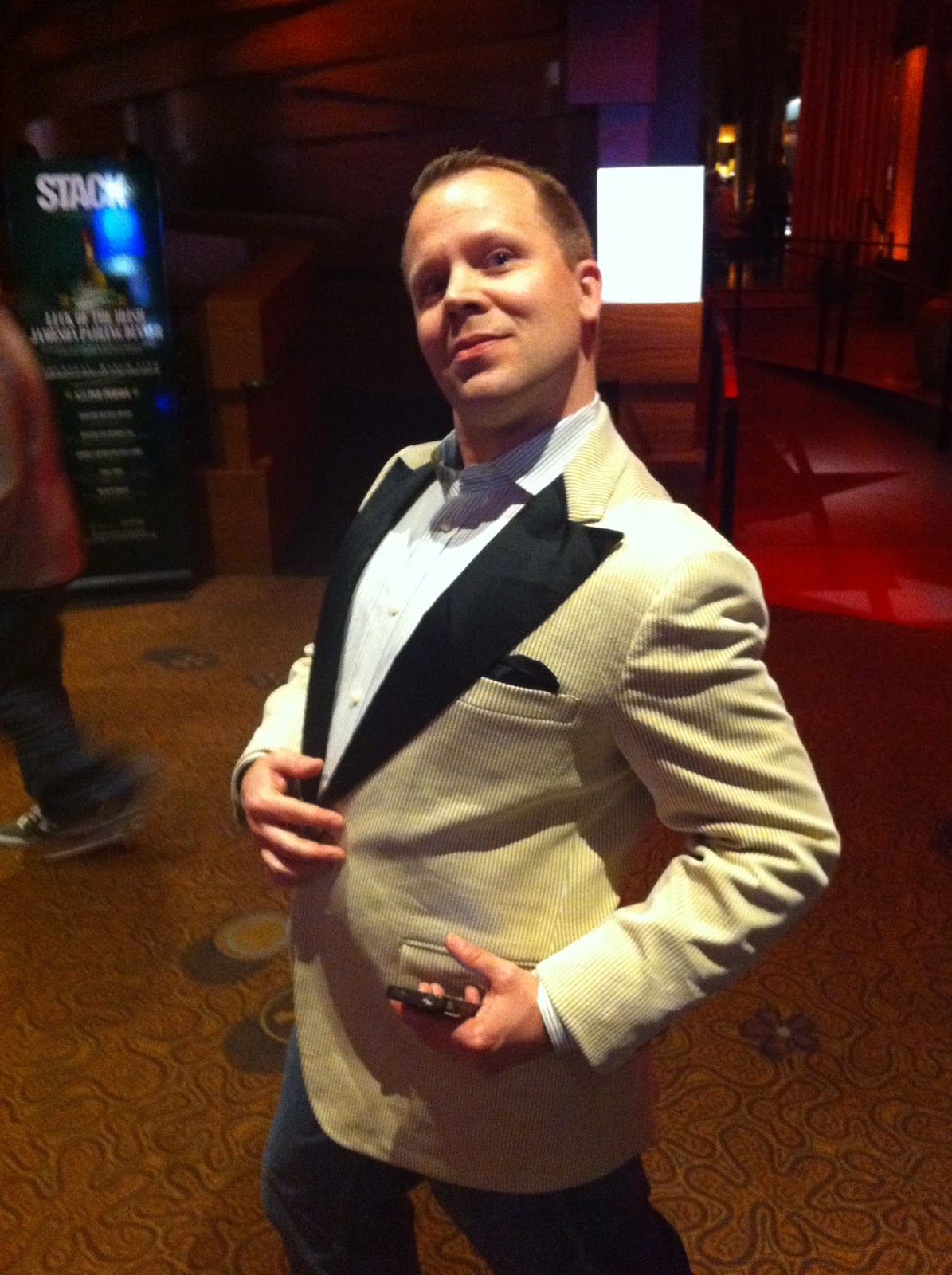
Jacket Dinner:  Stack at Mirage. Where do you think all the dookie came from? For lack of memory of actual results, and because history is an artificial construct created by the victors to establish a credible social narrative supporting their usurpation of power, the official Jacket Champion was Santa, with Lucky as First Loser.

Lucky looking suave.

Santa makes a statement:
"Even hookers won't hit on me tonight."


Champion:  None. Had any Ironman so much as walked away from Vegas up a solitary credit on penny slots, he would have won the IMOP-VII Championship in a rout. For those of you keeping score at home, rumor has it that the ironically named rookie Fun Bobby won as Leastest Loser.

As two-time defending IMOP Champ Barbie might 
have said if he wasn't busy 4-balling blackjack on credit
with a homeless guy by the Bally's pedestrian bridge:

"Sometimes, the only answer is another drink."