Showing posts with label Psychology. Show all posts

November 22, 2016

Dancing Gorillas at the Poker Table

Bonus update (23 Nov 2016):  My good friend Poker Grump wrote a great article over at Poker News on the same issue of selective attention a few weeks back. His article is better because he has a Penn & Teller magic video. So go read that article then come back here for dancing gorilla videos.

* * * * *

After several stressful months at the office, not to mention a mind-boggling Presidential election, a trip to Las Vegas came at just the right moment. A few days to unplug from the world were just what the doctor ordered. Poker. Good food. Cocktails. Friends. The Vegas Rock 'N Roll Half Marathon. Well, the last one was more the excuse for Vegas than the highlight, yet there is something awesome about being mere yards from a stage where Snoop Dogg is rapping about peace, love, and weed, before running for two hours in the neon glow of the Vegas Strip at night.

As has become the norm for my Vegas trips, I made my headquarters at Aria; still the best value for upscale hotel rooms, awesome poker room, and great mid-Strip location. But there may have been a donkalicious late night drinking session of 2-6 spread limit Hold Them at Monte Carlo. Allegedly. Unquestionably there was a side trip for a session of Pot Limit Gambooool at the new Wynn poker room (actually in Encore). This is a fantastic room, with restrooms and a sports book window conveniently located in the room, lots of space between tables, top shelf drinks, and a cool, upscale vibe. And, of course, no Vegas poker trip is complete without a late night session of Poker With The Drunks at Planet Hollywood, where I cashed out for nearly a grand in profit. P-Ho remains the gold standard for lucrative late night poker.

Monday morning rolled around, and I decided to squeeze in a last three hour poker session at Aria. My legs were a little sore from the race, but I was rested, caffeinated, and sober. I should have been ready to play my A-game. Instead, I ended up looking like a total idiot.

But, for a moment, let's digress. Take a quick look at this video.


You may well have already seen this video, which was the centerpiece of an exceptional bit of psychological experimentation. The point of the experiment was to test how people observed an overall situation when they were focused on one aspect of the situation. Here, where people were focused on the task of counting the number of passes made by the people in white t-shirts, half of the observers completely missed the gorilla walking through the scene. That's right. People who were intently focused on tracking one part of the scene were utterly oblivious to another part of the scene, even something as absurd as a gorilla.

The researchers called this psychological phenomenon selective attention. Essentially, when your brain is focused on one task, it mutes or outright ignores information unrelated to the task at hand. And it can manifest itself in a wide range of daily activities. Including poker. And in a game where observation is a key skill, overlooking important information can be a costly leak.

Back to my session at Aria. I got into a game where most of the players had been at the table together since early in the morning. And it was quickly obvious why. Most of the players were over $500 deep, with several having over $1,000 stacked behind. The table economy ran through a total maniac across the table who raised preflop more than two out of three hands. His standard play was to raise preflop by splashing a random handful of chips into the pot, usually $30-$80. Then, he would c-bet nearly every flop by jamming a big stack of $80-$150 into the middle. Of course, the maniac attracted multiple callers every hand, with players looking to catch a hand and take a bite out of the maniac's stack. For his part, the maniac, as maniacs are wont to do, caught improbable hand after improbable hand to vacuum up chips from tilty nits.

So how many times did I screw up in this session? The number of the counting shall be three ....

Hand #1:  Early in the session, I had roughly my $300 starting stack and was in the small blind. Maniac raised to $20, and I called with 75 soooted along with three other players. Flop was a gorgeous 7-7-5 with two hearts. Catamaran! We checked it around on the flop. Turn was another 5. Boo! I led out for $50, and got called by the big blind. Maniac and another guy folded, but the cutoff—a fairly standard older nit—raised to $150. Damn, pretty clear he has the other 7 and we're chopping the pot. So, I shoved, expecting the big blind to fold, the nit to call, and to run out the board.

Except the big blind didn't fold. Instead, he kept looking at his cards and thinking. He cut out chips for a call, and kept looking back at his cards and the board. Eventually, he sighed and mucked. I rolled my cards and said, "I flopped it, but guess now we'll chop it."

It was only then that I realized the old nit in the cutoff hadn't snap-called! That was ... awkward. And seconds ticked by as the nit stared at my hand, the board, and his hand. Finally, he reluctantly folded. Obviously he didn't have the last 7, so he might have had something like an overpair or possibly an open-ended straight flush draw. In any event, I likely cost myself his $100 or so call.

Hand #2:  Later in the session, I was on the button with the Spanish Inquisition6h3s. The table maniac raised to $30 and I called, along with three other players. The flop was interesting—9h5h4h—giving me an open-ended straight draw, but presenting the danger of drawing dead, I was prepared to fold to any bet, on the theory there is always a better place to get it in bad. But instead it checked around, and I gladly asked the dealer for a free card.

The turn was even more interesting—the 2s—giving me the straight. This time, the maniac threw out $50, basically 1/3 of the pot. Two players flat called, and I made the reluctant crying call.

The river was the 2h. Although I doubted there had been a slow-played set or two pair that boated, the fourth heart on the river was almost certainly the nail in the coffin for my straight. The other players took turns looking at their hole cards and checking. I checked and waited to see the inevitable showdown between big single hearts in the hole. As everyone stared at each other, I rolled my cards and dramatically announced, "I have a straight to the six!" hoping to prod the other players to show down and move things along.

Knowing my hand wasn't good, I looked over at the TV, waiting for the next hand. I heard the dealer announce "Flush wins." Well duh. But then, I saw the dealer pushing the pot to me. What the heck??

Oh yeah. I had a baby heart in my hand, so I had a flush, not a straight. Of course, I could only beat a naked 3h in the hole, but that was the only other heart held by anyone in the hand at showdown. Cha-ching! Feel like I missed a value bet there with that monster ....

Hand #3:  Once again, maniac opened in middle position for $35. Once again I called on the button with 8s7s. But to my surprise, the rest of the table folded. The flop was pretty good—Ah9s6c—giving me an open-ended straight draw. Maniac bet $50, I raised to $130, and the maniac auto-called. Hmm, he might have a hand this time. Turn was interesting—9c. Maniac checked, I bet $200, he called. At this point, if I didn't hit my straight, I was done with the hand. It was far too probable maniac had an Ace or 9.

River was not just a blank, it was a killer card—6h. Basically, if maniac has any Ace, 9, 6, or pocket pair, he wins. Maniac checked, and I checked. Maniac says, "You win," I respond, "I have eight high" and flashed my hand. Maniac goes, "Oh, I can beat that!" and tables QcJc. Ahhh, so he chased a flush draw, missed, and still has me beat. Sucks to be me.

I went to muck my loser hand when the guy next to me says, "Wait, you chop!" I paused, then realized that maniac and I were both playing the board because the Ace on board was the kicker for each of our hands. I tabled my cards, and we chopped the pot.

I ended up stacking maniac when I slow-played QhQd preflop, and we got it all-in on a flop of AsQcTc. Maniac showed Ac2c, which was stronger than I hoped. But the board ran out blanks and my set held up for a monster pot.

So back to selective attention. In each of these hands, I was so focused on one thing—a player's action or chasing my draw—that I missed other important developments. Of course, having it happen three times in a three hour session is not something I am terribly proud of. I'm certain that the circumstances—a last quick session, some residual fatigue, playing a maniac—contributed to the problem. But it's also a phenomenon that happens even to the best trained professionals; for example, a decent percentage of radiologists failed to detect a gorilla shape when reviewing CT scans for tumors. And for you smug folks who saw the gorilla in the first video and who are laughing at my stupidity, try this follow up test:


In any event, being aware of this psychological phenomenon will hopefully make it less likely to recur in my future poker sessions.

Or I'm just getting old.

January 10, 2011

The Vizzini Leak

Man in Black:  All right. Where is the poison? The battle of wits has begun. It ends when you decide and we both drink, and find out who is right ... and who is dead.

Vizzini:  But it's so simple. All I have to do is divine from what I know of you: are you the sort of man who would put the poison into his own goblet or his enemy's? Now, a clever man would put the poison into his own goblet, because he would know that only a great fool would reach for what he was given. I am not a great fool, so I can clearly not choose the wine in front of you. But you must have known I was not a great fool, you would have counted on it, so I can clearly not choose the wine in front of me.

Man in Black:  You've made your decision then?

Vizzini:  Not remotely. Because iocaine comes from Australia, as everyone knows, and Australia is entirely peopled with criminals, and criminals are used to having people not trust them, as you are not trusted by me, so I can clearly not choose the wine in front of you.

Man in Black:  Truly, you have a dizzying intellect.

Vizzini:  Wait 'til I get going!

The Princess Bride

The poison-duel scene in The Princess Bride is a comedy classic in which the villain, Vizzini, matches wits with the hero, the "Man in Black". Vizzini works through elaborate rationalizations for why the poison may have been placed in each of the two wine goblets, hoping to catch a tell by the Man in Black as to which goblet is truly poisoned. Eventually, Vizzini manages to talk himself into and out of believing that the poison is in each of the two goblets. Finally, he resorts to a ruse to try to cheat his way to the right solution, only to discover ... well, watch the scene and find out!

I often think of the Princess Bride poison-duel when confronted with a poker player who "tanks" for a ridiculously long time during a hand. I can only imagine the inner dialogue must run something like this:

"He overbet the river, so he's trying to look strong, so he must be weak, so I have to call. Except he knows that I know that "strong means weak", so he must actually be strong, pretending to be weak, so he looks too strong, knowing I will think he's really weak. So, clearly I must fold. However, he's a young guy wearing an Ed Hardy hoodie, so he's a big bluffer, so I must call. But he's only shown down the nuts tonight, and he has a tattoo of a donkey sh*tting diamonds out his azz, so he must have a strong hand, so I must fold. But ..."

It's actually kind of humorous to see some of these deep-thought moments at the table, when it's pretty obvious to most of the table whether the bet represents a value bet by an almond broker, or yet another bully bluff by the table maniac. It's truly astonishing how often these deep thinkers make the wrong decision.

A psychological quirk that might be in play in these situations is the surprising fact that deep analysis often becomes over-analysis, and over-analysis is often no better than a simple wild azz guess in terms of results. The fault in our thinking process arises from attempting to factor into our decision far too many factors, leading us to put undue weight on peripheral factors, or to minimize the weight given to key factors:

This is known was a “weighting mistake,” and it’s a serious problem for conscious deliberation. When we try to analyze our alternatives, we tend to search for reasons to choose one team over another. The problem is that we’re not particularly good at figuring out whether or not these reasons are relevant. In other words, we’re rationalizing, which is quite different from being rational.

—Jonah Lehrer, "You Know More Than You Know" in The Frontal Cortex (Oct. 12, 2010).

Studies have shown that the best decisions by experts are reached not by an immediate "gut" reaction, nor by a deeply analytical thought process, but rather by "intermediate decisions", where an expert is given the problem to consider, and then briefly distracted by other matters before being asked for their conclusion. In that situation, the expert has sufficient opportunity to allow his brain to rationally process the decision in light of the expert's knowledge and experience, but prevents the brain from over-analyzing the situation and out-thinking itself.

The upshot of this research is that, while we should approach problems rationally, sometimes more thinking is poor thinking. Although our immediate gut reaction at the poker table might provide a valuable starting point, it pays to give some extra thought before making our final decision. But it pays equally well if we learn when to turn off the logic circuits, because ultimately we can rationalize almost any play we want to make if we give our brain time to focus on the factors supporting that decision.

As any Princess Bride fan knows, two of the classic blunders are:  "Never get involved in a land war in Asia", and "Never go against a Sicilian when death is on the line." When it comes to poker, let me add this blunder to the list:

"If you find yourself talking yourself into a call or a fold, you're an idiot if you listen to that fool."

"You have defeated my Scandi, and bested my Grinder ..."

January 04, 2011

Avoiding a Titanic Poker Leak

But it’s a totally different story in a big game. If I raise it $3,000 or $4,000 and the other guy and I have a lot of chips on the table, he’ll be a little more hesitant about raising me now because he knows there’s a very good chance I’ll play back. The guys I play with know that when I put my children out there, I don’t like to let them drown.

—Doyle Brunson, Super/System2, p. 394

A few days ago, I played a cash game session at the Meadows ATM. During the game, I saw an example of what is probably among the top five poker leaks, at least among recreational players—calling with a hand you are fairly sure is behind solely because of the amount of money already invested in the pot.

The hand went roughly like this. There was a straddle, and just about everyone in the room limped into the pot. Straddler raised to $24, and there were four callers. The flop came out highly coordinated—something like 9h8h8d. Straddler led out for $75, and got two callers. The turn was the Jh. Straddler led out for $125, with both players immediately going all-in for ~$800 more and ~$100 more. Now the big stack had never once shown down less than the second nuts when putting big money in the pot, while the other player was an uber-tight older nit. Straddler thought a minute, then said, "Well, I've already put most of my money in the pot, I have to call," and called for his last $150. Sure enough, the big stack had 98 for the flopped boat, while the old nit had the nut flush. The boat held up for another monsterpotten to the big stack. Straddler claimed to have held AhAd, and left after busting on the hand.

Now the big leak in this hand is the Straddler's thought process. He was fixated on the size of the pot and the fact he had committed a lot of his chips to the pot. The problem is that this fixation on the pot size and prior action blinded him to the reality that he was likely either drawing thin or dead. In economics terms, the money already committed to the pot is regarded as a sunk cost. A sunk cost is essentially a prior expenditure that cannot be recovered. For example, a developer decides to build a casino on the Las Vegas Strip. Building commences, and the project is 50% completed, but then the economy tanks. The projections for income from gambling, conventions, shopping, and other resort activities are no longer valid and must be revised. The new figures show that the projected income stream from the completed casino will not meet the additional expenses needed for completing and opening the casino; in other words, the project cannot be finished at a profit. A rational developer would abandon the project, despite having already invested tens or hundreds of millions into the project. The money invested prior to the decision point is irrelevant to the decision regarding whether to complete or abandon the project. If the additional investment needed to complete the project will not result in a profitable venture, then there is no point in making the additional investment.

Turning back to poker, the amount you personally have invested in a pot is never a valid consideration governing your future play in the hand. Either you have correct odds to call vs. your opponents' range(s), or you don't. The amount you have "invested" or put in the pot up to the decision point is irrelevant; it is a sunk cost. The past is past, and that money is now part of the pot; it is no longer "your" money or "your" investment. Reasoning that you "have to call because you already put in $X" or "it's an easy fold because you've only invested $Y" is a major leak. A smart poker player will look only at the total pot versus the wager he is facing (and future implied wagers, where relevant) when making his decision. 

The problem is that many recreational poker players, because they are loss-averse, will improperly factor the sunk cost of their prior wagers into their decision making process. These players often improperly invoke the concept of being "pot-committed" to justify their ultimate decision to make a bad call. Let's look at an example. You flop a monster draw with QJs, but get to the river and have Queen-high after missing your draws (let's ignore your ineptitude in failing to get all-in on the flop). The river paired the board, so you decide to take a stab at the $500 pot, betting $300. Your opponent, a rock, goes all-in for $400. It's $100 to call into a pot of $1,200. You're getting 12:1 on the last call, but is your hand ever good here, let alone one out of every thirteen hands? Are you truly pot-committed here? Calling in these situations is a terrible leak, yet many recreational players make that last call because they're fixated on all the money they've already put into the pot.

There are circumstances where loose calls with marginal hands are warranted, but those loose calls must be justified by relevant considerations: your opponent's likely range based on his betting line and your reads, coupled with your knowledge of your opponent's playing style (particularly whether he is prone to bluffing or making value bets with marginal hands). Basing your decision to make a loose call on the fact that you've already put a lot of money into the pot is throwing good money after bad. Once you've paid enough money to know you're beat, why voluntarily pay even more for the privilege of losing the pot? Making a habit of making these bad loose calls will eventually sink your bankroll.

"Don’t make loose calls and hopeless bets to avoid giving up on the pot. It’s okay to leave your kids out there sometimes. Maybe they have soccer practice today."

—Schmidt & Hoppe, "Don't Listen to Phil Hellmuth", p. 112


If you're sunk, it's silly to go down with the ship.

(Image source).

December 21, 2010

The Fear of Money

"I think maybe the money's what's throwing you off here today."

—Vincent Lauria (Tom Cruise), in "The Color of Money"

During my recent trip to Vegas, I had a hand in a $1/$2 NLHE cash game at Imperial Palace where I folded Kings preflop, making that hand only the second time in my life where I had done so.  The action had been a raise by a tight player, a healthy reraise to $40 by me, followed by an immediate and strong reraise by the tight player, with the two of us looking at playing for ~$450 effective stacks.  The player was so tight, and the reraise was so strong, I open-mucked my Kings, thinking to myself, "He has to have Aces."  The tight player saw my hand and rolled over ... Ace-Eight sooooted.  Oops.

The first time I folded Kings preflop in a cash game was four years ago during my inaugural Festivus trip to Vegas.  I was playing at the Rio in a $1/$2 NLHE cash game, and had recovered from an early downswing to work my stack up above $1,500.  There were several other large stacks at the table and the game was playing loose and crazy.  In one hand, there was a raise to $15, and a reraise to $50.  I was in the small blind and found Kings.  I raised to $150.  First raiser pushed all-in for over $1,000, and the second raiser insta-called for nearly that amount.  Crazy.  I thought forever, and finally folded, figuring one of them had to have Aces.  They rolled over ... Ace-Yak soooted and Ace-King.  Yes, I play badly.

In both cases, I felt there was a good chance I was up against Aces.  My thinking was that it's better to make a small mistake (folding and conceding my initial raise) than to make a big mistake (committing a deep stack with Kings preflop).  Or, as my motto at the bottom of this blog states:  "There's always a better place to get it in bad!"  But in small stakes cash games, it's actually very difficult and highly unusual to be able to put a player on exactly Aces, or even a narrow range like Aces, Kings, Queens, and Ace-King.  Against that larger range, folding a hand like Kings is a major mistake.  So why did I make that mistake, not once, but twice?

Well, my decision-making process in these hands might have been the result of a common psychological aversion to losses, even when the risk of losses can be offset by an identical chance of gain:

... When Kahneman and Tversky framed questions in terms of gains and losses, they immediately realized that people hated losses.   In fact, our dislike of losses was largely responsible for our dislike of risk in general.   Because we felt the disadvantages of risky decisions (losses) more acutely than the advantages (gains), most risks struck us as bad ideas.  This also made options that could be forecast with certainty seem especially alluring, since they were risk-free.  As Kahneman and Tversky put it, “In human decision making, losses loom larger than gains.”  They called this phenomenon “loss aversion”.

—Jonah Lehrer, "The Allais Paradox" (The Frontal Cortex blog, Oct. 21, 2010) (emphasis added).

Now my poor decision to fold Kings preflop in these two hands is a negative expected value (-EV) play against any hand range other than exactly Aces.  The math is rather straightforward, and the decision to fold Kings preflop is—or at least ideally should be—driven entirely by the range of hands I can assign to my opponent(s).  I may have thought I was making a smart laydown by folding Kings, by not putting my deep stack at risk.  But in reality, I was forfeiting more than merely the preflop bet I had placed in the pot; I was also forfeiting my significant expected profits from winning the pot over 2/3 of the time.

However, there are several common poker situations where successful poker players must invest money with some significant degree of risk, and where a straightforward pot odds calculation cannot provide a direct answer as to whether committing chips to the pot is a profitable (+EV) move:
  • Bluffing when it is the only way to win the pot.
  • Semi-bluffing with a draw or marginal hand that is likely behind if called.
  • Calling with a marginal hand that is generally only a bluff-catcher.
  • Value betting the river with a good but not great hand (particularly heads up or when last to act and action has checked around).
In each of these situations, I think many low stakes cash game players err on the side of caution, failing to bet or raise because of a psychological aversion to losses.  In each of these situations, there is often significant value in risking additional chips to win a pot, even without knowing whether one holds the best hand, or even knowing for certain one doesn't hold the best hand.  Yet many players (myself included) will often timidly check and fold in these situations as a default move, rather than analyzing whether a bet or raise is a better expected value play.  In other words, poker players often incorrectly forfeit their interest in a pot out of a fear of losing even more money with a marginal or poor hand, when the more profitable move might in fact be to risk additional chips in an attempt to win the pot.

Even though many low stakes poker players have read books and articles about pot odds and expected value calculations, why do we keep making the error of playing too timidly?  I think an important distinction must be drawn between situations where odds calculations are precise, and situations where the odds are imprecise.  For example, most decent poker players can and do routinely calculate pot odds when they are holding a straight or flush draw; if the pot odds are not favorable, it is a routine fold.  But for situations involving making a bluff or making a call to pick off a bluff, the odds are imprecise, creating doubt and timidity in our analysis of the proper play:
    The first gamble corresponds to the hypothetical ideal:  investors face a set of known risks, and are able to make a decision based upon a few simple mathematical calculations.   We know what we don’t know, and can easily compensate for our uncertainty.  As expected, this wager led to increased activity in the parts of the brain (like the striatum) involved with the expectation of rewards, as subjects computed the odds and calculated their expected earnings.  Unfortunately, this isn’t how the real world works.  In reality, our gambles are clouded by ignorance and ambiguity; we know something about what might happen, but not very much.  When Camerer played this more realistic gambling game, the subjects’ brains reacted very differently.  With less information to go on, the players exhibited substantially more activity in the amygdala, a brain area reliably associated with fear conditioning.  In other words, we filled in the gaps of our knowledge with fear.  And it’s this inexplicable fright—an irrational by-product of not knowing—that keeps us from focusing on the possibility of future rewards.

    —Jonah Lehrer, "The Truth Wears Off" (The Frontal Cortex blog, Dec. 6, 2010) (emphasis added).

    Now the poker literature is rife with examples of expected value calculations for making or picking off bluffs based on estimates of the percentage of times an opponent is calling or making a bluff.  But the problem with these examples is that what is easy on paper is tough to apply in real life.  When was the last time you actually thought, "This player is bluffing in this situation 36.77% of the time"?   Instead, we are forced to deal with more of a gut feeling as to how likely a particular player is to be bluffing or calling our bluff in certain situations.  And that gut feeling leaves us with a feeling of unease, causing our instinct to avoid risk and prevent losses to kick in, making us overly timid in our play.

    Now it's important to understand that our instinct to avoid losses is a hard-wired psychological trait that we must overcome to maximize our success at the poker table.  But our loss avoidance tendency is different from playing with "scared money", which is when we risk money we know is needed for non-poker purposes, or when we put an excessive percentage of our bankroll at risk at one time.  Although both kinds of fear will have a negative impact on our play, the proper remedy for excessive loss avoidance is to be more aggressive, while the proper response to playing with scared money is to drop down in stakes or to quit playing until our dedicated poker bankroll is healthy.

    So, for my first New Year's poker resolution, I shall strive to overcome my fear of losses, and try to analyze hands where I would normally check or fold to determine whether an aggressive play might, in fact, be a better (+EV) play.  I will face my fear of large losses, recognizing there may be a larger reward for aggressive play.  I will push aside that knot of anxiety in my gut, and seek out that rush of joy that comes with stacking chips.  I will not be afraid at the poker table.
    I must not fear.  Fear is the mind-killer.  Fear is the little-death that brings total obliteration.  I will face my fear.  I will permit it to pass over me and through me. And when it has gone past I will turn the inner eye to see its path.  Where the fear has gone there will be nothing.  Only I will remain.

    —Bene Gesserit "Litany Against Fear" from "Dune", by Frank Herbert.

    December 19, 2010

    A Bad Beat Bakes My Noodle

    Oracle:  "I'd ask you to sit down, but, you're not going to anyway.  And don't worry about the vase."

    Neo:  "What vase?"

    [Neo turns to look for a vase, and as he does, he knocks over a vase of flowers, which shatters on the floor.]

    Oracle:  "That vase."

    Neo:  "I'm sorry."

    Oracle:  "I said don't worry about it.  I'll get one of my kids to fix it."

    Neo:  "How did you know?"

    Oracle:  "Ohh, what's really going to bake your noodle later on is, would you still have broken it if I hadn't said anything?"

    The Matrix

    The weekend after Thanksgiving, I played a session at the Meadows ATM.  A lot of discussion at the table surrounded the bad beat jackpot (BBJ), which was at a record $113,000 and climbing (I'm not certain if the jackpot has been hit in the past couple of weeks, having instead been playing poker in Vegas).  Now Prairie Meadows has fairly liberal rules as far as BBJs go:  the losing hand need only be Aces full of Jacks or better (one ace playing from your hand for full houses), while quads can be a qualifying hand without a pocket pair, so long as the hole card plays as a kicker (e.g., A8 vs. JJ would qualify on a board of 8-8-8-J-J, while 98 vs. JJ would not qualify—though it would still be a sick beat).  So, getting a BBJ up over $50,000 or so is a rare event.

    As is the usual case when BBJs get higher than normal, there were tons of stories flying around the table about BBJs previously hit, as well as the usual bad beat stories about BBJs nearly hit, or hit and disqualified (Prairie Meadows DQ'd one BBJ a few years ago because a player not in the hand saw the losing player about to muck and told him to table his hand).  My favorite near-miss story involves Fred, a local uber-nit (though I hasten to add that Fred is a decent fellow who has always been friendly with me).  About a year ago, Fred folded AdQd to a preflop 3-bet, and wound up missing out hitting a royal flush against another player's quads.  If you want to needle Fred, just muck AQs face up and say, "Fred, how would you play Ace-Queen suited?" with a completely straight face.  Hilarity will ensue!

    The point of this post, however, is to look at a common talking point involving BBJs—whether players sitting out of a hand deserve a table share (or some financial reward) when a BBJ hits.  For those unfamiliar with BBJs, it is typical to divide the jackpot between the winning hand, the losing hand, and the other active players at the table (or even all active players in the room).  Prairie Meadows awards 50% of the jackpot to the losing hand, 25% to the winning hand, and divides the remaining 25% among all other players who were dealt into the hand (they also allow an absent player to be dealt into one hand after leaving the table, so long as they have chips behind).

    It is common to hear players claim that, if a player sits out of the hand and a BBJ hits, they should still be given either a full table share, or at least a significant payoff from the winning and losing hands.  The theory behind these kinds of claims is that "the bad beat would never have occurred if Player X had been dealt into the hand, so Player X should be rewarded for causing the bad beat" (see this recent discussion thread over at All Vegas Poker (AVP) for a couple of examples of this argument).*  These kinds of claims are pure nonsense.

    The implicit premise underlying this type of argument is that Player X caused the bad beat by deciding not to play the hand.  After all, if Player X did not cause the bad beat, he clearly has no moral claim to any share of the jackpot ("moral" here used in the sense of fairness or equity, as opposed to a technical claim to a share, which the player clearly does not have under the rules).

    In order to analyze whether a player sitting out of a hand can be said to have caused the bad beat, let's first consider all the factors that require perfect coordination to bring about a particular bad beat:
    • First, the deck must be shuffled to permit a bad beat to occur.  That is, the deck must contain a series of cards that, when cut in the proper spot and dealt to the proper number of players, will result in a qualifying bad beat.  It is theoretically possible for some decks—likely most decks—to be shuffled so that no bad beat can occur.  It is also theoretically possible for a deck to be shuffled to permit more than one bad beat to be dealt, depending on the cut and the number of players.  Let's call a deck with at least one potential bad beat lurking in it a qualifying deck ("QD").
    • Next, the deck must be cut in the correct spot to bring the QD's potential bad beat into play. There is theoretically a 1/51 chance of the deck being properly cut to bring the bad beat into play.  However, because most dealers do not cut close to the top or bottom of the deck, a certain percentage of potential bad beats never have a chance of being dealt out of an otherwise QD.
    • Once the deck is cut in the correct spot, the proper number of players must be dealt into the hand.
    • Once the players are dealt in, the betting must proceed in a fashion that permits the two qualifying hands to make it to the river.  For example, a hand like 22 or 96s might be driven out by a preflop raise, or a hand like 88 might fold to a flop bet on an eventual board of Q-Q-J-8-8.
    • Player betting decisions may be determined by external factors.  A player holding a potentially qualifying bad beat hand may fold because of a large raise from a player who seems likely to hold a strong hand based on playing style or physical tells.  Or a player with a potentially qualifying bad beat hand may fold because they just lost a big pot and are looking to play only the strongest starting hands, or because another player in the hand is short-stacked and doesn't offer correct implied odds to play a suited gapper starting hand.
    • During the entire hand, there must not be a dealer error that affects the two qualifying pocket hands, nor the qualifying final board (e.g., no flashed cards, no premature burn and turn, etc.).  Note that there will be a certain number of non-QDs that can become a QD as the result of a dealer error which is corrected in the normal course of play (e.g., a flashed pocket card is replaced, a boxed card is discarded, a premature river card is replaced) (let's call these "near-QDs").  Bonus noodle baking—Should a player sitting out of a hand still get credit for "causing" a bad beat if the bad beat would never have occurred but for the subsequent dealer error?
    Notice that out of all of the necessary conditions for a particular bad beat, a player's decision whether to play a hand only affects one of them—the number of players initially dealt into a hand.  But an individual player's decision whether to play a hand is only one small factor in determining the final number of players dealt into a hand.  Let's consider a few common situations that affect player decisions whether to play a particular hand:
    • Player 1 is new to the table and must decide whether to post in (or take the blinds in Vegas), or to sit out and wait for the blinds to hit (or for the blinds to pass in Vegas).
    • Player 2 gets a phone call from his spouse.  He has to decide whether to take the call and be dealt out, or ignore the call and play the hand.
    • Player 3 is racking up to head home, and has to decide whether to see another hand.
    • Player 4 is supposed to meet his buddy for dinner.  His buddy drops by or texts to tell him either to leave immediately, or to play a few more hands, based on how well his buddy is doing at table games or in the sportsbook.
    • Player 5 is a nicotine-addict and has to decide whether to take a cigarette break or play.
    • Player 6 has to decide whether to take a restroom break or play.
    • Player 7 sees a friend across the room and has to decide whether to go greet him or play.
    • Player 8 is called to a new game or is given his table change request.  He has to decide whether to take a hand or move immediately.
    • Player 9 has been absent from the table and has to decide between paying his missed blinds and waiting for the blinds.
    • Player 10 just busted out and has to decide between buying back in short, locking up his spot while he hits the ATM to reload for a full buy-in, or calling it a night and letting a new player sit down.
    • In the case of one or more empty seats, there is an added decision by the floorperson whether to fill the empty seat(s) from the list, from a table change request, or from a table break, or whether to leave the seat(s) empty.  The floor decision is then followed either by a dealer decision to deal or wait for the new player(s), followed by the decision of the new player(s) to play or sit out that hand.
    Notice that, in a situation where a QD is in play, there will be up to ten relevant player decisions that affect whether the proper number of players are in a hand so that the potential bad beat may actually be dealt.  But, no one individual player decision, in and of itself, determines whether the bad beat occurs.  Rather, it is the aggregate of the decisions that ultimately matters.  After all, once a QD is in play, it doesn't matter whether a particular player is in a hand, it only matters that the correct total number of players are in the hand.  Thus, an individual player's decision to sit out of a hand is no more and no less important than the independent decisions of all the other players at the table to play or sit out of the hand.  However, the sum total of all of those independent player decisions are interdependent in creating the final conditions for determining whether the potential bad beat will be dealt.

    To think about the situation a little more deeply, let's say that a QD is in play, and exactly eight players are needed to be dealt into the hand in order for the bad beat to hit.  Six players are clearly going to take hands, but four players are making legitimate decisions whether to play.  If two of the four "on the fence" players sit out and two play, did the two that sat out "cause" the bad beat any more than the two that chose to play?  Did the two that chose to play that particular hand "cause" the bad beat any more than the six players who were going to play the hand regardless?  What if two of the players making decisions are friends who rode together; if one chooses not to play and his friend goes along with the decision, did the player who made the decision to leave "cause" the bad beat while his friend who acquiesced in the decision did not do so?

    Let's look at the same situation from a different angle.  Let's assume there is a QD in play. All that is needed is for exactly six players to play the hand.  But, because of various player decisions, eight players take hands and the bad beat is not hit.  Which two players do we "blame" for "causing" the bad beat to miss?  If that question strikes you as nonsensical, isn't it equally nonsensical to credit a player who sits out of a hand with "causing" a bad beat that hits?

    Just to be thorough, let's examine bad beats in online play (but first, you may want to take a quick look at these discussions by Shamus—Part 1 and Part 2—and Poker Grump regarding online card randomization processes).  According to PokerStars, they use a truly random shuffle to "set" an entire deck at the beginning of a hand.  PokerStars also utilizes "user input, including summary of mouse movements and events timing, collected from client software" as one source of entropy to ensure a truly random shuffle.  Based on this method of shuffling, should we consider each player whose "user input" contributed to the shuffle that results in a QD to be a "cause" of the bad beat?

    Now, to really bake your noodle, let's look at Full Tilt where, instead of "setting" an entire deck at the beginning of a hand, the software instead waits until a card is needed to be dealt to a player or to the board to randomly select a card from the remaining "deck" of undealt cards.  Since there will never be a QD in play (since there is no deck), can we ever claim that player decisions to sit out or take a hand "cause" a bad beat?  If one player's decision to auto-fold or mull over his playing decision causes the next random card to be drawn to "change" (i.e., be different), and the resulting card results in a bad beat, did the player's decision how fast to play his hand "cause" the bad beat?  More to the point, using Full Tilt's card randomization process, can we ever meaningfully consider any player decision to be the "cause" of a bad beat?

    The assertion that one player's decision whether to play or not play a hand "caused" a bad beat reminds me of the classic "Horseshoe Nail" proverb:

    For want of a nail the shoe was lost.
    For want of a shoe the horse was lost.
    For want of a horse the rider was lost.
    For want of a rider the battle was lost.
    For want of a battle the kingdom was lost.
    And all for the want of a horseshoe nail.

    Of course, for something as significant and subject to as many independent factors and decisions as the outcome of a large-scale battle, it is nonsensical to attempt to trace the root "cause" to something as minor and as remote as whether a horseshoe nail was in place. In reality, there were almost certainly hundreds of independent factors and decisions at play that contributed to the outcome of the battle.  Similarly, a poker bad beat hand is never dependent on one or even a few factors and decisions, and it is equally nonsensical to describe any one individual decision or factor as the "cause" or even a "cause".

    Perhaps the best way to analytically describe poker bad beats is to regard a hand of poker as an example of chaos.  Chaos theory describes:

    "dynamical systems that are highly sensitive to initial conditions" where "[s]mall differences in initial conditions ... yield widely diverging outcomes ... rendering long-term prediction impossible in general.  This happens even though these systems are deterministic, meaning that their future behavior is fully determined by their initial conditions, with no random elements involved.  In other words, the deterministic nature of these systems does not make them predictable."

    Any poker hand is "deterministic" in the sense that it plays out in a predictable manner pursuant to a consistent set of rules.  However, every poker hand is also highly sensitive to initial conditions, including the deck shuffle, the cut, player decisions and actions, dealer decisions and actions, floor decisions and actions, and even the decisions and actions of persons remote from the game itself (e.g., the decision of a player's spouse to eat dinner or keep playing slots).  Alter one or more of the initial conditions for a given poker hand, and the hand will likely play out in a significantly different manner with a substantially different outcome (the proverbial "butterfly effect").

    Viewed in this manner, any single player decision to play or not to play a particular hand is merely one of a large number of initial conditions for a given poker hand.  From time to time, there will be a very small subset of initial conditions for a given hand that may lead to a bad beat jackpot, but hitting the bad beat jackpot even in those situations requires the fortuitous combination of precisely the right subset of initial conditions.  Any one player's decision whether to play or not play a particular hand is no more significant than any of the other relevant initial conditions.  Although a player's decision to sit out of a hand may set up a relevant initial factor for the subsequent play of the hand, he has no more caused the resulting bad beat than has a butterfly flapping its wings in China caused a tornado half the world away in Nebraska.

    So, there's no logical reason to give any player at a table credit for "causing" a bad beat just because they made a routine poker decision.  After all, poker isn't craps.  Same dice!


    ------------------------------------------------------------------

    * Similar arguments apply to any "cooler" type of hand (e.g., AA vs. KK, or set over set), in which the hand would never have occurred but for various player decisions to play or sit out the hand in question.  But, the argument is most commonly raised in discussing bad beat jackpot hands.

    October 17, 2010

    Poker Massages—A Hidden Leak?

    Massage gals are a common sight in many larger poker rooms and at lengthy poker tournaments.  As an aside, I can't recall ever seeing a massage guy in a poker room.  Presumably there are plenty of qualified male massage therapists, theoretically a poker player should care only about the quality of the massage rather than the gender of the person performing the masage, and the pay seems good.  So, one has to wonder if the gender disparity is due to the fact more women go into massage therapy than men, or if most poker players are men and everyone (management, massage therapists, and players) just assumes male players want women performing their massages, or if male players actually do prefer massage gals to guys because of some psychological need (having the attention/touch of an attractive woman, or not appearing gay).  Eh, I frankly don't much care, it's just one of those quirky social things that pop up in poker.

    Anyway, I was thinking about poker massages the other day after reading an interesting blog post by Dan Ariely over at "Irrationally Yours".  Ariely discusses three interesting studies in which people received a 15-minute massage, a 45-minute Swedish massage, or were just touched on the shoulder by a woman (note:  these were three different studies, not three options compared in one study).  The studies reached interesting findings and conclusions:
    • Massage releases oxytocin, a chemical leading to feelings of well-being.
    • Massage recipients are more empathetic and trusting.
    • Massage recipients are more generous givers in a money "trust" game.
    • Massage recipients are more relaxed and less aggressive.
    • Massage recipients feel more safe and secure.
    • Massage recipients make riskier financial decisions when gambling or investing money.
    In essence then, massages can alter a poker player's psychological state in profound ways.  Now, a little bit of artificial positive feeling and relaxation might help a player's performance; think of all the players you know who play better after one or two drinks.  But taken altogether, the findings above show that massages might lead a poker player to be less aggressive, more willing to make risky plays, and more likely to pay off with weak hands or to chase draws.  It's at least something to think about next time you're tempted to pull a $20 bill or two out when the massage gal walks by your table.

    Of course, now that I think about it, the poker world should be grateful Phil Ivey appears to love getting massages at the poker table.  The Ivey juggernaut would be nigh-unstoppable otherwise!

    July 27, 2010

    I Gotta Wear Shades

    "Ut imago est animi voltus sic indices oculi."  (The face is a picture of the mind as the eyes are its interpreter).

    —Cicero

    "The eyes are the window to the soul."

    —English proverb

    In creationism, a significant argument against evolution is that the eye is too complex a structure to have developed in so many species merely by natural selection.  As usual, science has a strong rebuttal.  First, as a basic point, light (or more specifically, electromagnetic radiation from the Sun at all wavelengths) is such a critical energy source for life on Earth that it would be shocking if most species didn't develop some form of light-sensing organ.  Recent research into the genetic development of the eye has discovered a set of genes common to all species that developed an eye:

    The next question is where Pax genes and their resulting structures came from.  According to Gehring, they could have arrived in jellyfish via symbiosis with dinoflagellates—a family of single-celled marine plankton, some with human-like eye structures inside their single cell.

    Jellyfish absorbed dinoflagellates, speculates Gehring, after dinoflagellates absorbed Pax genes from red algae, which had absorbed light-sensitive cynanobacteria.  Gehring describes this as his “wild Russian doll hypothesis.”  His team is now searching jellyfish genomes for dinoflagellate genes.

    “Evolution is very conservative. It uses the things that function well,” said Gehring.

    Of course, there are many religious faith traditions, including many prominent branches of Christianity, which accept evolution as consistent with religious faith.  For these believers, the laws of nature—including evolution—are not something to be feared, but rather are evidence of the wonder of God's creation.  But for the hardcore fundamentalists, "the Bible is literally true" crowd, this type of scientific discovery is likely unsettling (or rapidly dismissed as fraudulent or flawed).

    However, I didn't mention this scientific discovery to start a religious flame war.  Rather, I found it interesting because it's WSOP time again, with the first episodes of the new season airing tonight.  The first night of action involved the $50K Players' Championship, won by well-known pro player—and November Nine Main Event qualifier—Michael "the Grinder" Mizrachi.  After watching two hours of final table coverage, I noted that none of the final eight players wore sunglasses.

    Wait a moment.  No sunglasses.  Let that sink in.  For the past decade, the de rigueur poker tournament player uniform has been sunglasses, baseball cap, and hoodie (or Ed Hardy or TapOut t-shirt—or Ed Hardy hoodie).  In fact, the attire is so ubiquitous that it's almost become a joke in many poker circles.  Yet the last eight players at this mega-buy-in tournament eschewed the sunglasses.

    Now, part of the poker uniform may merely be the result of the crossover of the college-age standard attire into the poker world, as youngsters who cut their teeth online take their game into casinos and major live-action tournaments.  Frankly, I rarely take too much notice of attire at the poker table as it is not a particularly reliable indicator of skill or style (though there are plenty of players who fit the uber-aggro d-bag profile dressed in the uniform, sustaining the stereotype).  But the sunglass angle might have a little more utility than the rest of the uniform.

    Psychological research has long known that various facial movements correlate with various mental or emotional states.  Recent research has refined this insight, finding that the eyes can give away valuable information, including what category of thought is taking place, and whether a person is being deceptive.  As Jonah Lehrer observed:

    The larger lesson is that the brain can't escape its embodiment.  Even abstract information—and what's more abstract than a random number?—is subject to the heuristics of physical movement:  Up means higher, down means lower.  Because the mundane world of Newtonian physics is built into the mind at such a basic level, we are forced to re-use these same mental shortcuts when thinking about math, or playing poker.

    Now, I have no doubt that the eyes can involuntarily reveal important information during a hand of poker, including whether a player is being deceptive, and the moment in time when a player reaches a decision about how to play a hand.  I also firmly believe that many successful poker players have learned to read other players by observing these kinds of physical tells, even if they are unable to articulate precisely the basis of their "read".  Often, you will hear a solid player say, "I just didn't think he had it" without being able to state how he read his opponent's eyes, face, breathing pattern, and other physical tells—his experience combined with his innate ability to read body language gave him what he might call a "gut feeling" that was every bit as important as other information such as the board and the betting of the hand.   I also believe that the best poker players have developed an ability to mask their own physical tells, making them harder to read.  Seriously, watch Phil Ivey or Patrik Antonius—do you think you could ever pick up a tell on either player?

    All of this scientific research into the connection between the eyes and the mind is particularly interesting in light of Daniel Negreanu's recent suggestion that poker tournaments ban sunglasses:

    Let's just say that guys like Russ Hamilton would appose [sic] such a ban.  I heard Durr say it on High Stakes Poker last week and he is absolutely right.  You should always be uncomfortable playing high stakes poker against someone wearing sunglasses.  I'm not making this up, it's just a fact.  Banning sunglasses helps to protect the integrity of the game against cheating.  For that reason alone, they should be completely outlawed from poker.  No other sport or organization would allow competitors a device that makes it easier for them to get away with cheating.

    I'm not entirely sure what Negreanu means by "protect[ing] the integrity of the game against cheating", unless he is referring to "daubing", where a special substance is used to mark certain cards, with the substance being invisible except to those wearing special contacts or glasses.  I somehow doubt that daubing is a major scam in this day and age.  On the other hand, Negreanu is correct that many of the "elite" poker players rarely if ever wear sunglasses at the table. 

    So, overall, I'm torn on the sunglasses in poker debate.  I don't wear them myself, and I think many people wear them thinking they are projecting a tough guy image when they actually are being mocked by others (seriously, in a 1/2 NLHE game, or a $60 tourney, do you think your sunglasses make a dang bit of difference?).  On the other hand, science supports the idea that poker players can give away valuable information via their eyes.  So, how can I fault a player for trying to minimize these kinds of subconscious tells by wearing sunglasses? 

    Oh wait, that's right.  People who wear sunglasses indoors are pretentious d-bags.  If you need sunglasses to disguise your tells, go back to your parents' basement and play some more $1 SNGs.  If you think wearing sunglasses at the poker table makes you intimidating, sit at my table so I can laugh in your bespectacled, tell-spewing face as I crAAKK you repeatedly, until you are too broke to afford bottle service at an overpriced poseur club, and go home alone to your online porn collection.  Save the sunglasses for activities like golf, driving, skiing, hiking, biking, hanging at the beach ... you know, stuff that involves the Sun.

    I'm heavenly blessed and worldy wise,
    I'm a peeping-tom techy with x-ray eyes.
    Things are going great, and they're only getting better.
    I'm doing all right, getting good grades,
    The future's so bright, I gotta wear shades.
     
    —"I Gotta Wear Shades", by Timbuk3

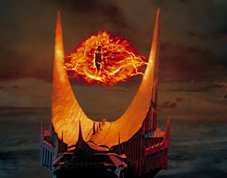
    Sauron never figured out why Gandalf always beat him
    at "Kings & Little Ones" in their weekly home poker game.

    (Image from here).

    July 17, 2010

    They're Always After Me Lucky Charms!

    They're always after me Lucky Charms!

    Every year during WSOP coverage, ESPN seems to have side coverage of card protectors, lucky charms*, and other superstitions.  Classic examples are Doyle Brunson's Casper the Friendly Ghost, Jerry Yang's family pictures, Sammy Farha's unlit cigarette, and Johnny Chan's orange, but occasionally the superstitions include more elaborate rituals:

    [WSOP bracelet winner Travis] Johnson insists he is not superstitious, yet he wore the same clothes over three consecutive days. He also admitted that he walked through the exact same door every single time he entered the tournament room.

    Now, I'm a fairly rational guy, more into science than mysticism.  Generally, I have to agree with those who take a dim view of poker superstitions.  But science sometimes gives us surprising, even counterintuitive, insights.  In a series of psychological experiments, scientists determined that maybe, just maybe, there is some value to lucky charms after all:

    Volunteers who had their lucky charm did better at a memory game on the computer, and other tests showed that this difference was because they felt more confident. They also set higher goals for themselves. Just wishing someone good luck—with "I press the thumbs for you," the German version of crossing your fingers—improved volunteers' success at a task that required manual dexterity.

    Keri Chiodo, Association for Psychological Science

    To be clear, this study is not scientific evidence that lucky charms or other superstitions have any inherent ability to change the course of fate—Doyle's Casper card capper doesn't change how the cards fall for the person holding it.  But, confidence is a major psychological component for a successful player, so if a card capper or other superstition makes a player feel luckier, then perhaps that player will actually play better, in essence making his own luck.  So, while skeptics like me likely will get negligible benefit from using a lucky charm, superstitious folks may in fact gain a significant advantage by following their "lucky" routine.

    ------------------------------------------------------------

    * Patty O'Brien has the ultimate take on lucky charms:

    June 23, 2010

    Poker Intuition—Going With Your Gut

    How often are you at the poker table when you get a "gut feeling" that a player either has a monster hand or is bluffing?  Maybe you're in the hand, maybe you're just watching, but somehow, you just know that player's hand.  And, how many times have you started thinking more about the situation, and analyzed the hand until you convince yourself that your gut feeling is wrong?

    Turns out, there's a scientifically valid reason to go with your gut instinct—the psychological concept of meta-cognition.  Meta-cognition is described as "thinking about thinking" or "feeling about knowing".  Meta-cognition is a self-awareness that you know a fact, without actually recalling that particular fact.

    Meta-cognition is in the news this week because of an IBM computer named "Watson".  Watson is a project to develop artificial intelligence algorithms by training a computer to compete at the game show Jeopardy.  Watson essentially runs thousands of different kinds of searches on a vast array of textual data in its memory, attempting to draw necessary connections between different concepts to arrive at a correct answer to a trivia question.  The interesting thing about the Watson project is that Jeopardy questions often involve complex wordplay that is easy for a human brain to decode, but difficult for a binary computer processor to analyze.  Watson has had spectacular successes and equally spectacular failures, but it seems to be ready for its upcoming showdown in a real Jeopardy match.

    So what does Watson have to do with poker?  An interesting finding from the Watson research is that human players have one inherent advantage over a computer—the ability to buzz in to answer the question without knowing the answer (or having the answer at immediate recall).  Instead, human players merely "know that they know" the answer and buzz in, trusting this gut feeling, and relying on their ability to actively remember the relevant fact within the time allotted.  Most of the time—in fact, an overwhelming amount of the time—the gut feeling is vindicated and the data is recalled correctly.

    Jonah Lehrer at The Frontal Cortex delves into the meta-cognition phenomenon:

    These feelings of knowing illustrate the power of our emotions.  The first thing to note is that these feelings are often extremely accurate.  The Columbia University psychologist Janet Metcalfe, for instance, has demonstrated that when it comes to trivia questions, our feelings of knowing predict our actual knowledge.  Think, for a moment, about how impressive this is:  the metacognitive brain is able to almost instantly make an assessment about all the facts, errata and detritus stuffed into the cortex.  The end result is an epistemic intuition, which tells us whether or not we should press the buzzer.

    The second important feature of these feelings of knowing is their speed.  As Thompson makes clear, it's the speed of these inexplicable hunches that allow the human contestants to defeat Watson.  Although our meaty computer only requires 12 watts of electricity—we are a damn efficient information processing device—we're still able to react before the supercomputer, which requires a massive air-conditioner to cool itself down.  In the human brain, these primal emotions have been bootstrapped to self-awareness, so that many of our feelings are short, speedy summaries of our own vast hard drive.  They are what urge us to raise our hand, or keep on trying to remember a name, or press the buzzer.

    In other words, what we often refer to as "gut feelings" are actually our brain's signal that we in fact know the answer to the problem confronting us.  We may not be able to articulate the precise answer without further thought and reflection, but we nonetheless do know the correct answer.  In poker, based on our experience and knowledge of the game and players, our gut can often tell us our opponent is strong or weak, without our being able to explain that conclusion in analytical detail.  With some thought, however, we can probably point to factors that led us to that conclusion—the bet size, the board texture, the action on prior streets, how the player is acting, etc.  So next time your gut tries to tell you something, make sure you listen.

    ------------------------------------------------------------

    For those of you interested in the IBM Watson project, here's an interesting video summary, including some footage of Watson in action during training rounds against former Jeopardy champions:

    June 21, 2010

    ET vs. Hannibal Lecter—Heads Up for Rolls!

    Hannibal Lecter:  First principles, Clarice.  Simplicity.  Read Marcus Aurelius.  Of each particular thing ask:  What is it, in itself?  What is its nature?  What does he do, this man you seek?*

    Clarice Starling:  He kills women.

    Hannibal Lecter:  No.  That is incidental.  What is the first and principal thing he does?  What needs does he serve by killing?

    Clarice Starling:  Anger, um, social acceptance, and, uh, sexual frustrations, sir ...

    Hannibal Lecter:  No!  He covets.  That is his nature.  And how do we begin to covet, Clarice?  Do we seek out things to covet?  Make an effort to answer now.

    Clarice Starling:  No. We just ...

    Hannibal Lecter:  No. We begin by coveting what we see every day.  Don't you feel eyes moving over your body, Clarice?  And don't your eyes seek out the things you want?

    The Silence of the Lambs

    I have often thought of this movie scene when confronted by one of poker's extreme playing styles—the calling station.  When confronted with an uber-calling station—an ET, if you will—the standard poker advice is:  "Never bluff a calling station."  Why not?  Well, what do calling stations do?  They call.  Clearly, an opponent calling is a poor result if you are bluffing.

    Although this is sound advice, the tactical analysis is misplaced on the proper response to calling stations, without focusing on the reason calling stations call.  Calling is regarded as an independently meaningful action, a product of rational thought, when it is actually a mere reaction, a manifestation of a player's underlying psychological state.  A calling station isn't calling because it is a logically sound play.  Instead, a calling station calls because something in his nature makes him call excessively, to his detriment.

    But why should we care why an opponent is a calling station?  Because knowing the underlying reason for excessive calling can help us tweak our tactics at the table to maximize our value from these players.  Consider these different psychological types of typical calling stations:
    • Donkey Calling Station—The classic calling station, this is the player who calls because he has an irrational fear of folding a winning hand.  The Donkey calls preflop with marginal cards, because if he folds and the flop would have hit him with two pair, trips, a straight, or some other monster hand, he feels he has made an error.  Postflop, the Donkey calls with any draw or pair, because he fears if he folds, his hand will improve to a monster.  On the river, the Donkey calls because he is afraid of being bluffed.  Being bluffed means you were hoodwinked, and the Donkey fears looking like a fool; losing a pot is not just losing money, it's losing faceA Donkey calls out of fear. 

    "Oh well, maybe he's bluffing again." 

    • Scrooge Calling Station—This is a slightly different kind of donkey, usually a decent to good player who has allowed catching a string of bad hands or being slapped around by a table bully to alter his natural style of play.  The Scrooge calls preflop with a wide range of hands, because he has seen his premium hands lose to "junk", and he is desperately trying to connect with flops to get some momentum rolling; surely this is the hand that turns it all around and gets his money back.  Postflop, when the Scrooge connects with the board at all, the Scrooge eschews betting and raising because he is afraid of building a big pot he will only lose, or because he is afraid he will get raised back and be forced to lay down his hand and give up his investment.  The Scrooge also calls much more loosely than he usually would, because he is looking for a reason, any reason, why he might win the pot just this one time—just this once, his opponent won't have pocket Aces, an overcard won't flop, he'll catch his draw, or his middle pair will pick off a bluff.  The Scrooge is calling solely because of the money; he can't lose every hand, can he?  A Scrooge calls out of greed.

      "Call big or call home!"

    • Hero Calling Station—This player should be regarded as a particularly aggressive caller.  Although that concept may be a bit counterintuitive, the Hero is not calling out of fear of being bluffed, but because he enjoys picking off bluffs.  Preflop, the Hero calls with a wide range because he expects to outplay you postflop, rather than beating you with a better hand.  Postflop, the Hero is not a player who upon occasion analyzes a hand and concludes he is most likely up against a bluff.  Rather, the Hero is a player who actively seeks opportunities to strut his stuff like a poker peacock, calling big bets with bottom pair or King-high just to show off his superior poker hand-reading ability.  The Hero loves to "put players on a hand" he can beat—Ace-King, busted draws, "air"—and will often go to extraordinary lengths to rationalize making a spectacularly thin call.  A Hero calls out of hubris.


    Each kind of calling station requires a slightly different response.  Preflop, if you are playing a relatively tight style with good starting hand selection, you should raise more liberally against a Donkey or a Scrooge, as both of those players are playing too many marginal hands, just hoping to connect with a flop.  There is good money to be made by building pots knowing that the Donkey or Scrooge will miss the flop and fold to a c-bet more often than not, and that even when they hit a flop, they will likely still be behind.  You should want to play big pots against calling stations willing to chase draws or call down with less than top pair.  By contrast, a Hero is not paying much attention to hand strength preflop, and building a big pot might play into a Hero's aggressive postflop style.  The key to maximizing value from a Hero is to have a good hand by the time the big bets get made on the river.  So, raise only your very best hands, and limp the rest.  There will be plenty of time to build a hand after the flop.

    Popstflop, the Donkey and the Scrooge are fairly similar before the river, willing to overpay on the flop and turn to chase draws (including two pair "draws"), just in case they "get there".  By contrast, a Hero calls (or "floats") on the flop hoping their opponent is continuation betting with "air" or a weak hand, and might show weakness on a later street.  If their opponent bets the turn, the Hero calls, certain that their opponent is still weak, maybe even being a bully and trying to buy the pot.  In any event, all three kinds of calling stations will call larger than normal bets on the flop and turn.  The Donkey and the Scrooge will call up to pot-size bets because they want to get to the river and see if they make their draw or their hand is good.  The Hero calls because he is looking for weakness, and an overbet of more than the pot looks weaker than a standard half to three-quarters pot sized c-bet. 

    On the river, the differences between the kinds of calling stations truly become important.  The Donkey and the Scrooge are willing to pay off a moderate value bet, usually up to about half the pot, with a marginal hand.  But neither will pay off a large bet on the river, as paying off a big bet loses face for the Donkey and money for the Scrooge.  However, because the Scrooge is generally a better player and more motivated by money, he is less likely to call with a weak hand unless presented good odds, so dial back the size of the value bet more for a Scrooge than for a typical Donkey.  By contrast, in the case of a Hero, it pays to overbet for value on the river, as the Hero is more likely to smell a bluff, is actively seeking out a bluff, and will seek the bigger psychological thrill from picking off what looks like a big bluff. 

    Looking at it in terms of postflop betting patterns, the different styles might look like this in terms of percentages of the pot:
    • Donkey:  Big-big-medium (75-100% / 75% / 50-65%)
    • Scrooge:  Big-big-small (75-100% / 75% / 25-30%)
    • Hero:  Big-bigger-huge (75-125% / 100-125% / 75-150%)
    One other major difference between a Donkey and a Scrooge is how they react to winning.  A Donkey will continue to be a calling station regardless of results, as his calling is driven by a fear of being shown up, of being wrong.  A Scrooge who wins a few pots, however, is highly likely to revert back to his "normal" playing style, whatever that might be.  After all, once he's won a few pots, the monetary incentive for irrational calling is alleviated.  So, with a Scrooge, be careful how you handle him once he has money; you'll likely find he's "switched gears".  The Hero, of course, will continue to find opportunities to show off for the crowd no matter how many times he is wrong, so long as he occasionally gets to preen after a successful call of a bluff (hopefully someone else's!).

    Calling stations are the most lucrative type of opponent over time.  Extracting maximum value from the ETs you encounter is a major key to profitable poker.  Doing so is certainly easier than dealing with maniacs!


    ET tries to cure Isildur1's bankroll "Ouch".


    After that donkey sucked out on the river, I ate his
    liver with some fava beans and a nice vodka-Red Bull.

    ---------------------------------------------

    * Lecter was apparently referencing this quotation from the Stoic philosopher:
    This thing, what is it in itself, in its own constitution? What is its substance and material? And what its causal nature [or form]? And what is it doing in the world? And how long does it subsist?

    The Meditations of Marcus Aurelius (translated by George Long)

    June 06, 2010

    Poker Leaks—Psychological Anchoring

    “It is a capital mistake to theorize before one has data.”

    —Arthur Conan Doyle, Sr. (creator of Sherlock Holmes)

    It is common in poker for a player to to make a river call with nothing more than a small pair, when to the rest of the table it seems obvious the bettor has a monster hand.  Often, the caller will shake his head and wistfully say, "I put you on Ace-King," or "I thought you had a busted flush draw".  Make this mistake a few times in a session, and those loose calls can be the difference between a profitable session and trekking to the ATM for a rebuy.

    Assuming a player is not a degenerate calling station, what leads to this leak?  The mistake often begins early in the hand, when we put a player on a narrow range of hands.  Then we compound the leak by sticking with that initial read, even in the face of contrary evidence.  For example, we have a tight image and raise in early position with Kings.  Our LAG opponent calls on the button, and we figure he has a pair or a big ace.  The flop is good for us, say 8-6-3 with two to a suit.  We bet the pot, our opponent thinks and calls.  We figure our opponent would raise with a set or an overpair, so we put him on a big flush draw with overcards.  Turn is another 3. Good card for us, as it doesn't complete a draw, and counterfeits our opponent in the unlikely event he had 86s.  We bet, he min-raises, and we call, figuring our opponent was making a stab at stealing on a junky board.  River is an offsuit deuce.  We figure we have to be good here, so we put out a value bet, and our opponent moves all-in for roughly the pot!  Hmmm, now what?  We can beat overpairs, the unlikely two pairs, and busted draws.  About all we can't beat is a flopped set (that improved to a boat or quads), and if he has that, well gawd bless him and pay him off.  We call, and our opponent shows ... Ace-trey suited for trip 3s!?!?

    What went wrong?  We made two crucial errors.  First, although we know our opponent is loose preflop, we still assumed he would have a certain range of hands because he should respect our preflop raise.  But our opponents don't always play the way we think they should play.  Second, we made a big mistake in not crediting our opponent's line as showing a strong hand.  Our line (preflop raise, big bet flop, bet-call turn, value bet river) looks like a big overpair.  Our opponent's line (call, call, min-raise, raise all-in) screams strength by the river.  If we are honest with ourselves, that line is so strong, our hand truthfully is no better than a bluff-catcher.  But, we failed to adjust our thinking when we gained additional evidence as the hand developed.  Instead, we figured our Kings were good preflop, and we wanted to find a hand we could still beat on the river so we didn't have to fold the river and give up the pot.

    What got me thinking about this "thin hero call" leak was a recent blog post by Jonah Lehrer at The Frontal Cortex, part of ScienceBlogs.com (a must-follow for science geeks).  Lehrer discussed a concept called "psychological anchoring" in which we are reluctant to give up our initial assumptions and conclusions, even in the face of new, different, and even contradictory evidence:

    I think we simply need to be more aware that our initial beliefs about a [situation]—those opinions that are most shrouded in ignorance and uncertainty— will exert an irrational influence on our subsequent actions, even after we have more (and more reliable) information. The end result is a kind of epistemic stubbornness, in which we're irrationally anchored to an outmoded assumption.
    ….

    The only way to avoid anchoring is to know about it. We need to be more aware that anchoring is a fundamental flaw of human decision making, and that our first reaction to an event will continue to shape our ensuing thoughts, even after that reaction is no longer relevant or valid. Our old beliefs might be wrong, but their influence lingers on, an intellectual anchor holding us back.

    Although Lehrer's post examined psychological anchoring in the context of our reactions to crises, I think the concept has application to other situations where decision-making requires ongoing analysis and adjustment to new data.  In the context of poker, we gain information with every action or lack of action at every point in a hand, and from every hand or event in a session.  Although we must, of necessity, begin each hand with a certain "default" set of assumptions, we must be ready to reevaluate, adjust, and even jettison those assumptions in the face of new evidence.  Analytical stubbornness or laziness can become an anchor dragging down our profits.