Showing posts with label Nostalgia. Show all posts

May 24, 2011

My First Big Bluff

The recent closure of the Sahara had me reminiscing about my first trip to Vegas in 2006. At that time, I had been playing poker in Iowa casinos for a couple of years, though the standard game had only recently evolved from limit to no-limit hold 'em. The game played a lot differently then, as well, with lots of soft players who could be run over by my uber-maniac style. Ah yes, the good ol' days!

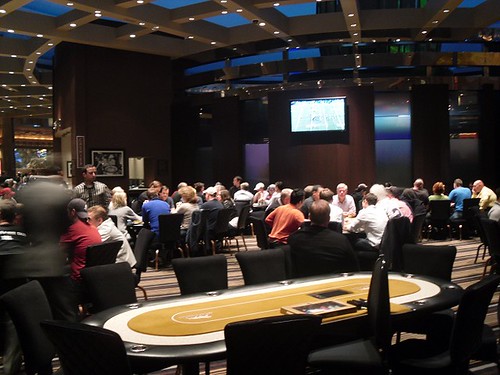
In any event, my vacation was mostly focused on hanging with college buds who weren't into poker, so I had only two days / one night left to myself at the end of the trip to devote to poker. I had booked a West Wing room at MGM, a mere minute's walk to the MGM poker room. At that point, the MGM room was easily the biggest and most impressive poker room I had ever played in. The marble ring around the tables was the most decadent thing I had ever seen in a poker room, and the crazy vibe from the Centrifuge bar nearby (with its bartenders and servers dancing on tables and the bar) was just too wild for my innocent Midwestern mind to comprehend. I had brought along $1,000 for gambling, so I should've stuck to $1/$2 NLHE. But the action was slow, limited by the max buy-in of $200. So, young arrogant me decided to jump into the $2/$5 NLHE game. Predictably, my stack suffered the wild fluctuations inherent in the LAG style (and the Stupid Style), and I quickly found myself putting my entire roll into play via rebuys and top offs.

Now, back in those days, there were plenty of soft spots at the $2/$5 level, and I managed to build my stack to nearly $2,000. But with several stacks twice that size in the game, I was always at risk of busting out. I played through the night, with a strange new sensation of tense anxiety clawing at my gut the entire time. Yup, for the first time in my poker career, I was actually scared money. As good poker players know, scared money might as well be dead money. But hubris wouldn't let me leave the game, whispering that there was tons of easy money to be made. Apparently God watches over drunks and poker newbies, and somehow I managed to dodge any big confrontations. Surprisingly soon, morning was rolling around, and I was thinking about cashing out to head to the room for a nap and shower before heading to the airport. Then, the hand happened.

I wish I could remember the details of the hand better, but all I can recall now is that I called a small raise on the button with a middle suited connector. I flopped a monster draw, which normally I would've played aggressively. But I was scared money, and with $2,500 behind at that point, I was looking to play cautiously. I called near-pot-sized bets on the flop and turn, figuring if I hit one of my draws, one of the two characters in the hand would pay me off for decent value on the river with an overpair. On the river, I missed my draws, but hit top pair no kicker on a raggedy board. Preflop raiser checked, so sensing weakness, I pushed all-in, getting the second yahoo to fold.

My remaining opponent was a young kid, one of those short, scrappy guys who liked to do a little good-natured trash-talking. He and his buddy at the table were fraternity brothers celebrating their recent graduations, and the three of us had grown friendly while playing together for nearly 20 hours, as other players cycled through the game. There was a sense of rapport between us, and we'd exchange knowing glances at yahoos and donkeys, while informally soft-playing each other, overbetting with big hands and checking it down with marginal hands.

My river shove on this hand was a major overbet of the pot, and was consistent with our practice of betting our big hands when playing each other. My opponent tanked. Then, he asked me, "Can you beat a set?" That fist of anxiety was clubbing me even harder in my gut. I was going to go home broke from my first Vegas trip.

My opponent rolled over a flopped top set. I threw up a little in my mouth. I casually said, "Wow, I didn't know you were that strong!" This was probably the first honest thing I had said in over twelve hours. My opponent said, "Why bet so much? Did you hit the straight?" I looked at the board. Yes, the river had made an open-ended straight draw get there. I said, "Do you think I'm crazy enough to call you with a draw?" and laughed. My opponent laughed, too. "Yeah, you love your draws!" Yes, yes I did.

I had one last card to play, literally. I casually rolled over my non-paired card, which was one of the cards needed to make the obvious straight. I leaned back, took a swig of my Captain & Coke, and said, "You'll have to call to see the other card." My opponent tanked, but finally said, "I have to believe you. You haven't lied to me all night." As he mucked, he asked to see my other card. I obliged as I raked the monster pot. My opponent came unglued. "How could you do that to me? After we've played together all night, you do that to me? That's bullshit!" Suddenly, his baseball cap went flying across the poker room, landing near the Centrifuge bar.

His buddy laughed.

Hilarity ensued.

I racked up and cashed out with a very fortunate profit.

And so began my love affair with poker in Sin City.


March 06, 2011

Making Laws and Sausages

"Laws, like sausages, cease to inspire respect in proportion as we know how they are made."

John Godfrey Saxe (often mistakenly attributed to Otto von Bismarck as "Laws are like sausages. It is better not to see them being made." or "To retain respect for sausages and laws, one must not watch them in the making.")

One of the best perks of growing up on a farm was that meat was never lacking on the dinner table. We had two huge chest freezers in the basement, one for pork and one for beef (meat only filled half of each freezer, with the rest of the space reserved for bread and farm-grown vegetables; to this day, I despise canned veggies). When meat ran low, another steer or pig would be hauled off to the local butcher shop. Steaks, ribs, roasts, hamburger, bacon, ham ... you name the cut of meat, we enjoyed it on a regular basis (often with tasty homemade gravy; farm food is truly tough to beat!).

One problem with butchering whole animals is that you wind up with packages of some less than tasty cuts of meat—jowls, tongues, hearts, livers, shanks, and yes, whole heads. So, every fall, Grandpa would come over and we would go back to our German roots and make sausage.

The process took most of a day. First, the meat had to be cooked. Next, it had to be cranked through Grandpa's family heirloom hand meat grinder (see pictures below). Then, the meat had to be seasoned and mixed together. Finally, the meat had to be run through a sausage stuffer to be made into links (for the sausage that was made in link form). Once finished, it was off to the freezer, waiting for a cold winter morning or evening to be brought out for a hearty meal.

We usually made three types of sausage. My favorite was a breakfast sausage which was made by adding oatmeal to the sausage while it cooked; when fried with lard (what did you expect, canola oil?), the oatmeal on the outside would make a crunchy crust, while the meat and oatmeal inside remained a creamy texture. Another tasty sausage was brain sausage, made from lighter colored cuts of meat, along with head meat and, yes, cooked brains; the sausage was seasoned with diced raw onions and garlic, then stuffed into casings. While we're at it, "casings" is a fancy word for "intestines"; yes, traditional sausages are stuffed into intestines which have been cleaned and stretched, and are entirely edible when the sausage is cooked. The final regular sausage was a dark sausage, made with liver and darker meat cuts, and more heavily seasoned with black pepper and paprika, again stuffed into casings.

The great thing about our homemade sausages was that—much like your standard hot dogs, bratwurts, andouilles, chorizos, salamis, and other commercial sausages—they took scraps of meat that were otherwise shunned as "gross" and transformed them into something absolutely delicious. The sum was unquestionably greater than the parts. Yes, I knew full well what went into the sausage I ate, but I frankly didn't care. The end product was all that mattered.

A classic poster advertising the Universal Food Chopper.

A closer look at the parts of the meat grinder, which is remarkably
well-designed to be easy to assemble, clean, and store.
(Apparently you can buy one on Amazon.com for only $29.99!)

This is a pretty good look at how the meat looks going in and coming out.
(Heavy duty model from Sausage-Stuffer.com).

A good picture of the style of sausage stuffer used by my grandpa.
The casing attaches to the hole at the bottom. The top is unscrewed on the right
side near the crank, then pivots up to allow the sausage to be put into the device.
When the top is screwed back down, the crank operates the screw mechanism
to twist down a heavy metal plate lying on top of the sausage, which in turn
presses the ground sausage down and into the casing.

This past week, I had the opportunity to testify in front of a subcommittee of the Iowa legislature in support of one of three bills I drafted at the request of a group of businesses and insurance carriers. It was an interesting experience, advocating for a complicated bill in front of a group of legislators who had little expertise in the area of law this bill addressed, and facing down a half dozen or so opposing lobbyists. After the meeting, the lobbyist who had asked for my assistance gave me a rundown of the chances for the three bills I drafted, as well as the legislative process going forward. The lobbyist gave me a list of concerns raised by opponents, and asked what areas we could compromise on (and language that would be acceptable), and what areas couldn't be touched. Although all three bills passed out of committee as written, we have already hammered out compromise language to propose if needed to secure additional votes, either in the House (where the bills originated), or after the bills (hopefully) move over to the Senate.

As most poker players are aware, the Iowa legislature is also considering a bill to legalize online poker within the state. Officially labeled SSB1165 ("SSB" means "Senate Study Bill", indicating a bill introduced via a committee chair without a designated sponsor, a tactic often used for bills on controversial topics), the bill sets up a regulatory system for intrastate online poker along with addressing issues related to horseracing purses and eliminating periodic county voter approval of casino gaming. These latter two topics are controversial gaming issues that might either help or hinder the cause of online poker; such is the risk of making sausage.

The poker bill itself sets up a mechanism for state gaming commission approval of one or more "hub" websites that would provide online poker subject to requirements for providing adequate security for private information and preventing underage gambling and fraudulent activities. Interestingly, although Caesars Entertainment operates the WSOP online poker website overseas as well as the Horseshoe Casino in Council Bluffs (near Omaha, with perhaps the best poker room in the state), the company has not yet committed itself to the proposal either for or against. Even more interestingly, the bill contains a strong "bad actors" provision which would prohibit current online poker sites from ever qualifying for licensing. So, if this bill passes, the choice for Iowa online poker players will be one of, at most, two or three (and possibly only one) online poker sites—not including Full Tilt, PokerStars, UB, Cake, etc. On the flip side, the poker site would be legal and regulated, providing players with legal protections against fraud and cheating they currently do not have.

To my mind, one important question remains unanswered—is online poker limited to the state of Iowa economically feasible? Proponents of the bill claim that approximately 150,000 Iowans regularly play poker online, and that online poker will generate approximately $30-$40 million per year in tax revenue. Under the bill, online poker will be taxed at the same rate as other gaming, which works out to essentially 22% of gross gaming receipts. Doing the math, the bill's proponents must expect online poker players in Iowa to generate gross gaming revenues (i.e., rake) of approximately $135-$185 million per year (actually somewhat more, as the gaming tax has a graduated structure capped at 22%).* That works out to an average of $900-$1,200 in rake per player, per year; no matter how you slice it, that's a lot of money being siphoned out of the Iowa poker scene solely in rake. Now, hard core recreational players and semi-professional grinders might generate that kind of rake, but the average microstakes player probably will be playing well below that projection. Even assuming new players flock to the legalized version of the game, I can't imagine many of them will be playing often enough or at high enough stakes to support these kinds of expectations. Also, online players who bust out a few times might simply give up the game altogether, killing the golden goose. Forgive my skepticism, but I doubt that Iowa's population base will support online poker profits consistent with these projections, certainly not on a long-term basis.

The moral of all this musing is that passing laws can be like making sausage in two widely divergent ways. Often, the legislative process can bring together a number of unpalatable proposals and churn out a delicious result, a pepperoni or bratwurst of a bill. A federal bill legalizing online poker which balances the concerns of poker players, Indian casinos, land-based casinos, off-shore poker sites, law enforcement agencies, and anti-gaming moralists might prove to be tasty and satisfying. But sometimes, legislation takes some crappy ingredients and spits out a completely inedible concoction. Regrettably, I fear that the Iowa online poker bill is nothing more than a stinky liverwurst.

"Politics is the art of the possible, the attainable—the art of the next best."

Otto von Bismarck

-----------------------------------------------------------------
* By way of comparison, in 2009, Iowa's seventeen casinos together generated annual total gross gaming revenues of $1.3 billion and net gaming tax receipts of $306 million. In other words, online poker alone is projected to bring in roughly 10%-15% of the amounts generated by all casino gaming in the state. To my mind, this seems to be a rather "pie in the sky" projection.

January 21, 2011

Moving Along

Time, time, time, see what's become of me
While I looked around
For my possibilities.
I was so hard to please.
But look around, leaves are brown
And the sky is a hazy shade of winter.


—Simon & Garfunkel, "Hazy Shade of Winter"

My posts have been a bit sporadic the past couple of weeks, and they are likely to remain a bit sporadic into the near future. However, let me explain. No, wait, there's no time. Let me sum up.

After nearly 16 years as a lawyer—ten of them as a full shareholder—with my current law firm, I am leaving for another career opportunity. Yes, I have finally been offered a spot as a Wall Street hedge fund manager and international playboy.

Naww, it's nothing that exciting. Instead, I've gone corporate, taking a spot as "Vice-President and Assistant General Counsel—Litigation" for a regional insurance company. Essentially, my job will be half management (monitoring complex or high exposure claims, overseeing outside counsel, and supervising in-house attorneys), and half litigation (defending first-party claims against the company). The job will offer a lot of variety and interesting legal issues, which is nice, considering my current practice rarely offers much in the way of intellectual challenges. Also, the pay and benefits are much better, and the long-term financial prospects are substantially better than remaining at my current job. Plus, the commute is all of five minutes.

Now, there will be some downsides to the new position. I won't have near the flexibility in terms of taking time away from the office, and my first year or so will require a ton of work getting my feet wet. Also, I will miss all the good folks at my current firm, where I have made many friends over the years. But, in a way, as the firm has grown, it has of necessity become more corporate, which inevitably leads to changes—and tensions—in relationships. It's kind of like a home poker game. It starts out as a few friends having some drinks, laughing, and pushing chips around. Then a few more people start joining in, and eventually, you have 30 players, house rules need to be written down, people focus more on money and less on camaraderie, petty disputes morph into long term grudges, and other players look less like friends or neighbors than another guy with an ATM card that resets at midnight (never mind that he probably can't afford to lose any money). Don't get me wrong, business and poker are about money. But never kid yourself—when the stakes get high, money can be corrosive to even the best of friendships.

Thankfully, this opportunity knocked at a great time. I wasn't looking for a different job, but this position is an amazing career opportunity and an interesting challenge. More importantly, I'm able to leave my firm while still on great terms with all my friends. After another five or six years in the firm, I'm not sure that I could have guaranteed such a happy outcome.

I don't believe in fate, but sometimes, things do just happen for a reason.


(Image source).

January 03, 2011

My Roots Are Showing—St. Matthew's Cemetery

"All things must come to the soul from its roots, from where it is planted."

—Saint Teresa of Avila

Over the Christmas weekend, I went back to my hometown in southwest Nebraska. One afternoon, Dad and I took a tour of the countryside, visiting the various plots of farmland and pastures my parents own, on which I toiled my pre-college life away. On our drive between a couple of farms, I asked Dad to swing by St. Matthew's Cemetery, a country cemetery where most of my relatives on my Dad's side of the family are buried. 

St. Matthew's holds a spot in my heart because from when I was in 5th grade until I headed to college, my brother Kevin and I helped my Grandpa and Great Uncle Walt with maintenance at the cemetery. Once every two weeks or so, the four of us would take push lawnmowers, hedge clippers, and weedeaters up to the cemetery to keep things presentable. Thankfully, the typically dry Nebraska climate along with the prairie grasses in the cemetery generally made mowing less of a regular issue than in more rainy eastern climes. During water breaks (where Grandpa or Uncle Walt would invariably produce some candy bars from their jug of ice water), Grandpa and Uncle Walt would share stories of the folks buried in the cemetery. Sometimes it would be to share the family genealogy. But more often, it would be stories of the lives of those now gone, and in many cases, long past. How people I would never meet led lives and met fates that intersected with those of my ancestors. Stories of immigration, assimilation, famines, droughts, floods, illnesses, fires, blizzards, tornadoes, and yes, wars. 

In many ways, my hometown was a typical rural Midwestern community. Generations of the original founding families lived, died, married, and had new families, resulting in a crazy quilt of inter-relationship between the locals, where everyone was at least second cousins with most of the other folks in the area. Lots of good German family names populate St. Matthew's Cemetery—Huxoll, Niemeier, Hormann, Meyer, Hilker, Stagemeyer, Meyerle, Schaben, Mües, Rodenbeck, Haussler, Menze, and Kaiser. My family name goes back five generations in the area, and is an immigration official's corruption of the original German "Müch". Even today, a few of the local old-timers still see me and inquire "How are the Müch boys?" (pronouncing it as "Muck").

St. Matthew's was a country church, started by German Lutheran immigrants. Services were generally in German, and my Grandma, who was among the last generation to worship in the church, kept a German hymnal from the church after it closed prior to World War II—even then, the decline of rural farm life was well under way. By the time my Dad was born, the church was long gone and the cemetery was the only remaining vestige of a former age. Yet, enough of the founding families remained that the cemetery was not only maintained, but continues to operate and serve as a final resting place for the modern descendants of the original founders even today.

St. Matthew's Cemetery is a peaceful, restful place, located in the prairie hills just a few miles north of my hometown. If it weren't for the fence and the tombstones, the cemetery would be indistinguishable from the adjacent pasture land. Yet in many ways, that little cemetery is more of an anchor for me than anything else in my childhood home. Those summer days spent with my Grandpa and Uncle Walt, learning the history of my ancestors, connects me more to "home" than anything other than my parents themselves.

After the jump are quite a number of pictures of the cemetery, with comments. Feel free to pass on these if you wish, as they likely mean a great deal to me and are not particularly relevant to y'all. However, if you want to know a little more about my heritage, here's your chance.


We begin with a series of photos capturing the extent of St. Matthew's Cemetery, taken from the main entrance, sweeping from east to west, with the cemetery to the north of the main gate (the cemetery lies on the north side of a gravel county road, with another gravel county road running along the east edge, and with pasture land to the north and west):


By the main entrance on the south edge of the cemetery is the original St. Matthew's Church bell, which is still rung for funerals and Memorial Day and Veterans' Day services:


Here is what I regard as the most beautiful, yet perhaps also the most heart-wrenching tombstone in the cemetery, for the child (Magdalene) of the St. Matthew's pastor and his wife, who died the day she was born:


Another great old tombstone of some distant relatives, celebrating the eternal bond of matrimony:


A couple of pictures of an ornate old tombstone for an Ernst Kaiser, who passed away before World War I led to a change in the family name (think Muslim names post-9/11):


Perhaps my favorite, and the saddest, story in the cemetery. These tombstones are for the Kleinbeck family, in which an entire family of 12 perished in a freak accident in October 1900, crossing the aptly named Republican River in a farm wagon during a flood. The small headstones are for each individual family member (my Grandpa and I recovered the burial plot from an overgrowth of lilac brush when I was in seventh grade):


Some pictures of tombstones for my ancestors from the Mües side of the family. Note my one Great-Uncle who served with the First Armored Division in World War II, seeing horrific action in North Africa and Italy, yet making it home safely. 


My ancestors from the Hormann side of the family. Note one Great-Great-Uncle who served in World War I, and eventually died from the lingering effects of German mustard gas attacks:


Some of my ancestors from the Niemeier side of the family:


Now, onto my Mock family ancestors.  First is my Great-Great-Grandpa Henry (note the delicate oak leaf scroll work which is suffering from years of exposure to the Nebraska elements; also, his wife—my Great-Great-Grandma—is buried next to Henry, yet her name has never been inscribed on the monument, whether through oversight, economic issues, or the chauvinism of the day):


Next, my Great-Grandparents, Carl & Mary Mock, my first ancestors born in the United States:


Finally, the current Mock family burial plot, which has tombstones for my Grandparents, my Great-Uncle, and my brother; my parents will eventually be buried to the right hand side of the photo. Even though my Grandpa bought the plot ages ago (as in, before I was born), note how it is in the most "modern" segment of the cemetery:


Close-up of the tombstone for my great-uncle Carl, who was mildly retarded after a childhood viral infection and fever. I remember doing farm work with Uncle Carl and playing cards with him at family gatherings. My Grandpa basically looked out for Uncle Carl until he passed away, after which my Dad took over that caretaking role. Uncle Carl was a kind man who, though none too sharp, still could play a mean game of pitch. Incidentally, the windmill on his tombstone is a dead ringer for several windmills I operated as a kid, providing water to cattle out in the pasture:


The tombstone for my Grandpa and Grandma. Grandpa died unexpectedly of a heart attack when I was about to start eighth grade. Grandma, like her siblings, made it into her nineties, rather impressive for someone who grew up on the prairie without electricity or running water until many years into married life, and who endured the Great Depression. Grandpa and Grandma's Golden Anniversary may have been the last of many great family gatherings in my childhood (I have 12 cousins on my Dad's side of the family, not to mention four Aunts who can cook like nobody's business):


Finally, we have a close-up of the tombstone for my older brother Scott (whose passing is discussed in this prior post). Scott lived in Colorado after college, and was always a nature junkie, so I love the peaceful pastoral scene for his tombstone:


Thanks for indulging my trip down nostalgia lane. We'll return to your regularly scheduled poker hijinks programming in the near future.

April 30, 2010

My Roots Are Showing

During my trip back to sweet home Huskerland yesterday, I got slow-rolled (or rolled slow) by a truck, but the lengthy drive was otherwise rather pleasant.  Of course, most of the trip was on I-80, which is not particularly interesting to most out of state drivers, but the speed limit in Nebraska is 75 mph (with traffic going 80-85 mph) so the countryside flies by.  Plus, with ESPN and Fox Sports talk radio available via XM radio, the trip isn't nearly as long and boring as it was back in the days of fighting with my brothers in the back seats of a late 70s station wagon on family trips.

Once I got off the interstate near Grand Island and took Highway 281 to head north to St. Paul, I saw a number of interesting signs and sights that were part of my farm background that many of my friends and readers of this blog might not be familiar with.  So, on my return trip, I made a few quick pitstops to snap these pictures on my iPhone.  Hope you enjoy!


Follow the Red Brick Road:

Red brick streets in the St. Paul business district.

St. Paul is a small town (population ~2,200), but it is a county seat, which is still a big deal in rural Nebraska.  A part of the tradition for many county seats (which were historically older and wealthier towns before their decline since the farm crisis in the 1970s) was to have paved streets by the county courthouse.  The original paving was done with bricks, but St. Paul's relative historical wealth was flaunted by extending the brick paving to the entire business district (the brick paving runs from the railroad tracks about four blocks ahead of the camera to a dozen blocks or so behind the camera where you can find the courthouse, school, and public library, and to most of the immediately adjacent side streets).  The city has maintained the brick paving despite paving the rest of the town using more modern methods.  As kids, when we visited our grandparents, we used to walk to a city park located by the trees in the upper left side of the photo.  My grandmother worked in a drugstore on the left side of Main Street, while my grandparents' house was a couple of blocks to the right side of Main Street.  Interestingly, for years my grandparents were neighbors to the Lynch family, creators of the famous Dorothy Lynch salad dressing (well, famous and popular in the Midwest, at least).


Sarah Palin, Used Car Salesperson:

Funny sign on the outskirts of St. Paul. 

I was reminded of this classic Saturday Night Live skit:


Bin There, Done That:

Farm grain bins.  These are set back from the road, so the telephone
pole creates a perspective that the bins are smaller than actual size. 
Bin "rings" are ~ 3 foot high, so the large bin on the left is ~ 21 feet to the
base of the peak, and the peak adds an additional ~10 feet in height.

Grain bins are a common sight in farm country; every farmer has several for storing and sometimes drying grain that is not taken directly to the local elevator for sale during harvest.  The large bin above probably can hold ~10,000 to 13,000 bushels of grain (assuming a 24' or 27' diameter base), while the smaller bins will hold 1/3 to 1/2 as much.

We would often move grain out of bins for sale or to grind for livestock feed.  Let's just say that scooping grain inside a dusty steel bin during the middle of July is not a fun summer vacation activity.  It's even worse when your brothers (allegedly) have allergies to grain dust and get to do other chores.  Jerks.


Use Your Melon:

Roadside melon stand near St. Libory, Nebraska.

The area between Grand Island and St. Paul has sandy soil suited to growing watermelons, muskmelons (mostly cantaloupe and honeydews), pumpkins, and squash.  There are several roadside farmer-owned melon stands along Highway 281 that have been around for decades.  Some Nebraska produce may have made its way into your fruit salad or pumpkin pie.


Making It Rain, Nebraska Style:


Typical "center pivots" used for irrigation (standard length is 1/4 mile long).

If you hit a big score in Las Vegas, you can "make it rain" at, ahem, a gentlemen's club.  In western Nebraska, where actual rain can be scarce, irrigation is often necessary.  On our farm in the aptly named Republican River valley, we used water from a nearby reservoir for gravity flow irrigation via pipes or siphon tubes (pictures of both techniques available in this discussion of "furrow irrigation").  In hilly areas, however, center pivot irrigation is the only option, using water pumped up from the Ogallala aquifer, a major aquifer in the Midwest (as an aside, the aquifer's name-source, Ogallala, Nebraska, is on the edge of the beautiful Nebraska Sandhills).  If you've flown to Las Vegas from the eastern United States and passed over Nebraska, Kansas, Oklahoma, Texas, or Colorado, and looked out your window, you've probably seen large green circles inside square fields.  The green areas are the potions of the fields irrigated by the center pivot, usually panted to corn, soybeans, or other "cash crop", while the corners are typically planted to a dryland grain crop (e.g., wheat or sorghum) or a forage crop (e.g., alfalfa or grass for hay).


Cattle Rustlers Beware!

Most of western Nebraska is cattle country, and cattle branding is taken seriously.

Calves are typically weaned in May or June, and the process of "working calves" can be a rather tough few days of work, depending on the number of calves.  Calves are first separated from their mothers, then taken to a place with a squeeze chute to allow vaccination, castration (males), dehorning, tagging, and branding, before then being taken to the feedlot to begin the process of being fattened for eventual sale and slaughter.  Even though grazing in Nebraska is not "open-range" and cattle are usually kept in fenced-in pastures, cattle do find ways to break through fences, and branding is an easy way to separate mixed herds.  More importantly, with the recent economic downturn, cattle rustling is on the rise across the country, including in Nebraska.  So, inspecting the brands on cattle being sold or transported to an area without brand inspection procedures is an important process for ranchers.

When I was in 4-H, I got a purple ribbon for giving a 10-minute discussion and demonstration on brands and branding at the Nebraska State Fair.  Yup, I was a farm geek.


Hot Vacation Spots:

Great place names!

If you're sick of the South Beach diet and the Atkins diet, may I suggest a Diet of Worms?

Well, hope you enjoyed my nostalgic trip down the backroads of Nebraska!  Next time, we'll discuss pulling calves, and other glamorous farm chores.